
Victims Commissioner urges UK and Irish governments to put victims first in legacy laws
 Reading time: 3 minutes
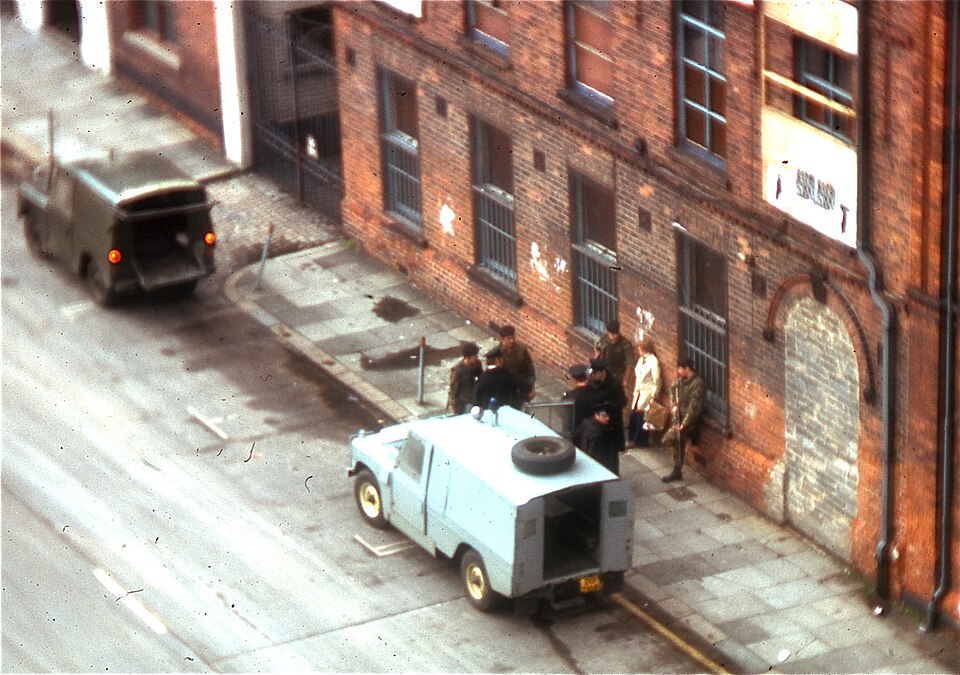
Belfast 1974
Credit: George Garrigues [GNU Free Documentation License]
Commissioner for Victims and Survivors Joe McVey has called for the needs and experiences of victims and survivors to remain central to the development of legacy legislation, warning that arrangements which fail to reflect their needs risk prolonging uncertainty and undermining confidence in efforts to address the past.
The call follows his appearance before the Oireachtas Joint Committee on the Implementation of the Good Friday Agreement on Tuesday 3 November, where he highlighted new research examining the continuing impact of the Troubles/conflict on people living in the Republic of Ireland (ROI).
Commissioned independently by the Commission for Victims and Survivors Northern Ireland (CVS), the survey of 2,000 adults found that 45 per cent of respondents whose physical and/or mental health had been affected by the Troubles/conflict continue to experience those effects.
The research also found that 83 per cent believe victims and survivors living in the ROI should have access to the same services and support as those in Northern Ireland, while 82 per cent believe it is important for the Irish Government to address the legacy of the Troubles/conflict.
The findings come as the Northern Ireland Troubles Bill progresses through the House of Lords and the Irish Government develops its own legislation under the UK-Irish Joint Framework.
Mr McVey said: “The Joint Framework represents an important opportunity to make progress for victims and survivors who have waited far too long for answers, acknowledgement and justice. But legislation alone will not address the legacy of the Troubles/conflict. What matters is whether the arrangements being developed can respond to the needs of those who continue to live with its consequences.
“In Northern Ireland, we have seen the challenges of developing legacy arrangements and the importance of ensuring victims and survivors have a voice in that process. Their experiences have helped inform our advice and engagement with decision-makers, highlighting where proposals need to go further and the safeguards necessary to build confidence.
“As the Irish Government develops its own legislation, there is valuable experience to draw upon, both from the challenges encountered and the progress made in Northern Ireland. We would welcome the opportunity to share that learning, alongside our research, to help inform arrangements that reflect the needs of victims and survivors.”
The research also highlights strong public support for acknowledgement, with 96 per cent believing it is important for the UK and Irish Governments to acknowledge harms for which they were responsible.
Mr McVey added: “We welcome the Irish Government’s acknowledgement of the experiences of victims and survivors and their families. However, acknowledgement must be accompanied by practical measures that respond to their needs, including appropriate support and meaningful access to information, answers and justice.
“Victims and survivors are not a homogeneous group. Their experiences, losses and needs differ, and it is essential that the arrangements being developed recognise those differences.
“The decisions being made now will have consequences for generations. Independence, impartiality and meaningful involvement of victims and survivors must remain central if both governments are to develop arrangements capable of earning their confidence and delivering lasting progress.”

Share this article:

Subscribe to our newsletter to not miss articles like this one:
 SUBSCRIBE