

Written by:

Review: The secret life of the Irish woman who became Britain’s greatest code-breaker
 Reading time: 3 minutes
Written by:
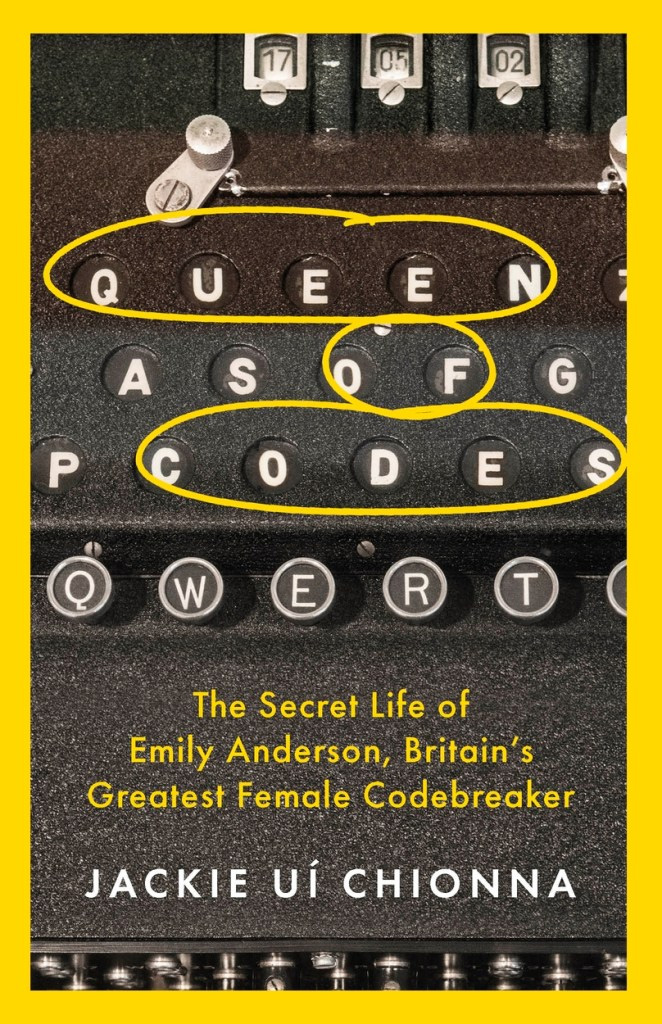
Robert Shiels reviews a new book on Emily Anderson, the Irish woman who became Britain’s greatest code-breaker.
It is no exaggeration for Jackie Ui Chionna to subtitle her biography the ‘secret life’ of Emily Anderson. The paucity of relevant departmental material and Anderson’s avoidance of a paper trail as to her work as a civil servant meant that her role in cryptography was lost to historians.
Anderson was born in 1891 in Galway. Her father was a professor of natural philosophy at Queen’s College there and later appointed President of the College. She studied languages there and proved to be a brilliant linguist, particularly in German.
The early part of the book shows Anderson to be well-travelled in Europe, and she lived in the homes of German families as part of her studies. She attended several German universities. After some teaching, she returned home to be the first professor of German at Galway.
With the war against Germany in 1914 there was a serious demand for translators and interpreters. Anderson was appointed as such on a temporary appointment for the duration of the war, and after the war that she took it up as a full-time occupation.
Anderson worked ostensibly as an official in the Foreign Office. In reality she, with the highest linguistic skills, and by the way a sound understanding of mathematics, was a cryptographer or code-breaker, dealing in the post-Great War era with diplomatic material.
Anderson was one of the first codebreakers to move to Bletchley Park, and later she transferred to Cairo where she decoded diplomatic and military intelligence that was of the greatest importance in ensuring victory.
The astonishing aspect of the life of Anderson was what might now be described loosely as her hobby. Her patience, linguistic skills and her musical interest led to the first publications of the correspondence of, separately, Beethoven and Mozart translated into English.
Her patience allowed her over many years, and all at her own expense, to tackle the notoriously difficult handwriting of Beethoven. Prepared and organised translations in English were published to the universal acclaim internationally of musicologists.
Jackie Ui Chionna has completed a superb piece of historical investigation which has resulted in an excellent biography that certainly deserves the many very favourable comments of the earlier reviewers, as printed in the introductory pages of the paperback edition.
It is to be recalled that Anderson worked in the secret service and deliberately left little of a known personal paper trail. In an era of the general and absolute acceptable of the necessity of the confidentiality of official secrets there is now not a lot to refer to at times.
This is an important book in the history of military intelligence, and the life of Emily Anderson who seems to have been the supreme practitioner of the art of the cryptographer.
Queen of Codes: The Secret Life of Emily Anderson, Britain’s Greatest Female Codebreaker by Jackie Ui Chionna. Published by Headline Publishing Group, 418pp.

Share this article:

Subscribe to our newsletter to not miss articles like this one:
 SUBSCRIBE