


Written by:

Review: The lost traditions of Labour and the working class
 Reading time: 7 minutes
Written by:
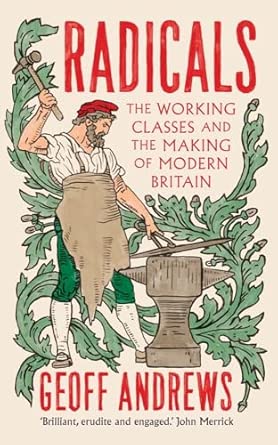
Geoff Andrews’ Radicals traces the working-class traditions, educational movements and moral values that shaped modern Britain and the Labour Party. This thoughtful review praises the book’s erudition and sense of loss, while questioning its limited attention to nationalism and regional experience across the United Kingdom.
The idea for this book developed in the mind of Geoff Andrews because, in his estimation, there has been a virtual removal of the working classes from modern political discourse, and an absence of them in the party founded to represent their interests.
He has noted the serious condition of decline of the labour movement; and, indeed, he asserts that the terms ‘labour movement’, and even ‘working class’ have been reduced to items of curiosity, or they have assumed entirely new meanings.
Moreover, attempts to counter the absence of the working classes in politics, art or media often veer towards crude reductions of their values or ‘identity’ to fit a seemingly homogeneous entity.
Andrews makes the point that the massive group he considers in his interesting book have always been “heterogeneous, multilayered, working classes [his emphasis] with different aptitudes, strengths, weaknesses and occupational and regional variations”.
In the past, it may be recalled, there had been for certain politicians only one single working class, whose advance to a better life was predicated on the ‘simple’ principle of bringing into public or collective ownership the means of productions, distribution and exchange.
Andrews has identified as significant Thomas Wright, a skilled tradesman who wrote under the pseudonym of Journeyman Engineer, amongst others, and in his evening work as a writer based on independent study encapsulated many of the ideas of the working classes then.
Wright was a moderate reformer and free-thinker who supported the campaign for an eight-hour day; and his trade union involvement made him, in Andrews’ estimation, a sharp critic of unfairness and discrimination.
All that shaped Wright in his belief in the importance of fellowship and loyalty towards other members of his class, with duties to the wider community and the common sense that influenced their actions and attitudes.
Practical experience at work, and as an autodidact, instilled in Wright the possibility of intellectual freedom. Andrews presents a substantial body of material to support his argument for the forgotten importance of Wright.
Andrews also gives prominence to ‘ethos’, which he takes to be “the sentiments and traditions of the people who created and controlled” the Labour Party. Those concepts shaped a reformist and gradualist outlook. It is contrasted with revolutionary class-conscious doctrines.
That ethos was distinguishable also from that of the Conservative Party and the Liberal Party. The argument is that the Labour Party ethos was derived from an experience and sense of exploitation. In none of this does Andrews mention the aspect of constitutional Unionism.
In an interesting and lengthy survey of the celebrity reformers and the relevant literature, Andrews argues that popular republicanism and claims for representation underpinned by popular equality were embedded in British radical politics.
Loyalty to the movement is deep-rooted in Labour ethos, in which virtue comes through trade unions, and earlier from friendly societies. The broad-based nature of the loyalty, Andrews argues, made it more durable than the doctrines in other movements.
Due recognition is given to the evidence of the ethical commitment to equality as a unifying factor. While that appealed to many, it was mediated in some respects by Fabianism that amounted to the socialism of the ‘comparatively well-to-do’.
On the importance of ‘ethos’, Andrews concludes that for many later socialist thinkers, he specifies five individuals in the twentieth-century, the moral case for socialism was aligned with a radical patriotism.
In surveying the place of radicals, the importance of education is stressed regularly by Andrews. An interesting explanation of the development of workers’ educational opportunities features Ruskin Hall, Oxford and the Central Labour College, London.
The aim of such education, in the minds of those who founded Ruskin, was that it was linked to human needs and the intellectual and moral improvement of mankind. Others thought the issue was between a general liberal education or the provision of socialist training.
Andrews discusses at length the place in socialist literature of a major work of fiction, Robert Tressell’s The Ragged Trousered Philanthropist. Furthermore, the General Strike of 1926 is also covered extensively, with reference to ambivalence among middle-class literary circles.
Throughout, Andrews discusses significant and often well-known literature of relevance to the cause. The real issue, perhaps, was the extent to which the middle-class intellectuals, often authors in their own right, knew best how to deal with questions around socialism.
That literature was of special relevance in the context of the democratic tradition of adult education, which is of interest to Andrews who showed potential himself and via higher education left a job in the post office and came to be a lecturer in higher education.
The short study of the Open University in this work is valuable in itself as an illustration of what determined politicians can do if convinced of the correctness of a policy: a studied and sustained indifference by the older leaders of the universities had to be overcome.
The narrative shows conclusively how the division grew between activists for the working class and the presence of members of the manual workers. The political developments in the years from 1997 led to a demand from leaders to “modernise” and “reconnect with civil society”.
Precisely what all those vacuous phrases actually meant in political practice was then and may now not be known. What is certain is that the socialism, in broad effect concern for the place of people in society with regard to those least able to assert themselves, had gone.
There can be no sense of superiority in asserting that this book by Andrews omits the concept of nationalism. The two Scots who established and administered the Central Labour College, in London, subsequently “disappeared after claims of financial malpractice”.
There is, however, insufficient recognition by Andrews that the working classes were indeed to be found across the whole of the United Kingdom. In that regard, his omission reflects the earlier literature. The attempted advance to a classless society varied incrementally by region.
The adult education movement, it has to be noted, is narrated interestingly, for those who care even now, but there were various educational opportunities, as John Maclean MA (Glasgow, 1904) was pleased to prove, but nothing is said by Andrews of that.
Finally, the roll of those wealthy intellectuals in the perpetual golden triangle of London, Oxford and Cambridge who were concerned about the plight of the working classes is impressive: but it is now a bit odd, although there is now, of course, ‘No. 10 North’.
Geoff Andrews took advantage of the educational opportunities available to him in the past and he has made much of them. His narrative is erudite and the loss is heartfelt for a disappeared world of the working classes, overtaken by events that may not be for the better.
RADICALS: The Working Class and the Making of Modern Britain by Geoff Andrews. Published by Yale University Press, 290 pp, £25.00

Share this article:

Subscribe to our newsletter to not miss articles like this one:
 SUBSCRIBE