

Review: Judgement in the age of AI
 Reading time: 5 minutes
From ancient sages to contemporary leaders, there is broad agreement that judgement is an indispensable quality a person must possess for making good decisions. Even the staunchest AI advocates, who explain all the things which AI already can or will soon do better than humans, emphasise that human judgement remains irreplaceable. With AI coming after many people’s jobs, it seems sensible to learn more about judgement and how you can improve yours.
What is judgement?
Philosopher John Locke described judgement as the key quality necessary to handle situations where there is no clear and certain knowledge and such knowledge cannot be had. But that doesn’t help us improve.
Fair enough, we know poor judgement when we see it: the embarrassing affair that gets found out, the disastrous video that repelled your customers, the drunken accident, the corrupt favour for an influential colleague, a war someone started but cannot win.
Good judgement is harder to pinpoint. We could go by track record: surely somebody with a good marriage, healthy kids, successful business, nice house must have good judgement? But track records explain little. Whether success or failure, track records don’t account for luck and contingencies like accidents, the state of the economy, being at the right place at the right time, good genes, the weather, inheritance etc.
That’s unsatisfying. Judgement is critical in so many aspects of life: who should I hire for an important role? Should I continue with my unprofitable business? Should I call it quits on my marriage? Should I have another child? Should I take on this risky new client? Should I challenge my boss on their latest harebrained idea? Should I change jobs?
Likierman’s judgement framework
Professor (Sir) Andrew Likierman proposes a working definition: judgement is the combination of relevant knowledge and experience with personal qualities to form opinions or make decisions.
Knowledge and experience you acquire throughout life, while your personal qualities are part of who you are. Likierman first discusses the key elements that comprise judgement:
- Knowledge and experience (understanding and accepting uncertainty);
- Awareness (self-; other- and context awareness);
- Trust (whom and what to trust);
- Feelings and beliefs;
- Choices (judgement is needed to develop credible choices and then decide which one to go for);
- Delivery (it needs judgement when and how to execute a choice; though not all choices or judgements require action).
How to improve my judgement?
Sir Andrew then arranges the elements of judgement into a framework that the reader can adopt and use to improve their own judgement, decision-making and execution skills. He further discusses prominent issues that affect judgement and how one could tackle them, including:
- Risk (including that judgement isn’t the same as caution);
- Groupthink and diversity;
- Speed, procrastination, inaction and stress;
- Biases, gut feelings and instincts; and
- Culture.
What else does the book offer?
Sir Andrew applies his framework in a variety of contexts. In easily readable chapters, he discusses judgement in leadership positions; at board level; for professional advisers (lawyers included); in HR and hiring situations; judgements in public sector and non-profit organisations; start-ups and first-time projects.
He ends the book with an FAQ around common questions, such as whether judgement can be learned (Yes), whether it improves or worsens with age (both) or whether judgement is the same all over the world (core fundamentals seem similar but what good judgement looks like in one culture may not translate into another).
There is also a little self-test on the twenty most common biases, though amusingly (perhaps just to me), he does not mention the bias blind spot: a bias describing the human tendency to detect biases and errors of judgement in others but much less so in ourselves. Though perhaps that’s why he recommends that you do the test with someone you trust and who knows you well, so they can keep you honest.
Do I need a PhD in psychology to understand the book?
No. Unlike some academics, Sir Andrew spent as much (or more) time in the business world as he did at the lectern. He founded start-ups himself and has participated in a multitude of enterprises, listed and private, as adviser, chairman and director.
His writing is practical, plain English, chapters are readily digestible without dumbing down the complexity of the topic. His recommendations will require you to reflect, think and be honest with yourself.
I found the book engaging, interesting and like to think it could help me to improve my judgement in certain areas of life. Whether I succeed, time will tell.
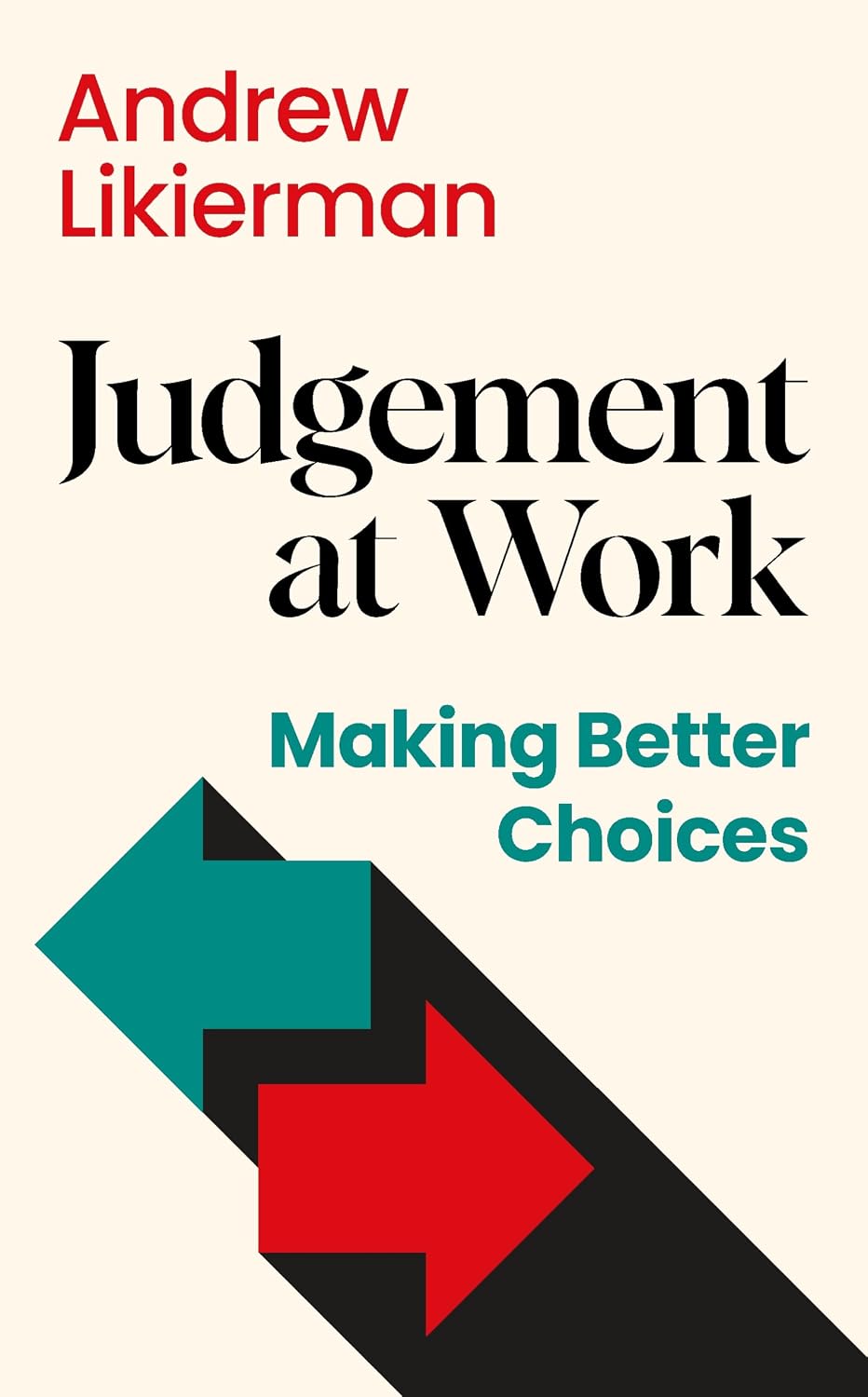
Judgement at Work – Making Better Choices by Sir Andrew Likierman, published by Profile Books, 304pp, £16.99.
Benjamin Bestgen is a solicitor and notary public (qualified in Scotland). He holds a Master of Arts degree in philosophy and tutored in practical philosophy and jurisprudence at the Goethe Universität Frankfurt am Main and the University of Edinburgh. He is the author of “Practical Jurisprudence — Attempts to make legal philosophy interesting” (2022).

Share this article:

Subscribe to our newsletter to not miss articles like this one:
 SUBSCRIBE