

Review: America’s lethal obsession with guns
 Reading time: 4 minutes
Gun violence in the United States is of interest to Malcolm Gladwell because the country has far more homicides than any other comparable place in the world. Why did the world’s wealthiest country experience a problem typically only seen in the world’s poorest countries?
In seeking an answer, Gladwell draws on his own original interviews, as well as archival and social science research. He approaches the American paradox through a series of real experiences of people involved; for example, a young gunshot victim in Washington, DC.
One point seems notable from the outset when reading the book. The print is large, and the paragraphs have more than ample space around them (“ventilated”). This might have been physically a much smaller book, more probably a series of long articles.
Gladwell travelled as a matter of reportage from North Carolina, to the South Side of Chicago, to an old plantation house in Alabama, concluding that the country does not understand its most pressing social problem, and as result, does not understand how to fix it.
This book is about the fundamentally dishonest way Americans talk about their gun violence. It examines the manner in which Americans misdiagnose the nature of their violence. Consideration is given to the moral recklessness of the course the country has chosen.
The discursive nature of the inquiries of the Canadian author means that he considers a wide range of topics bearing on weapons: the statistics and the dishonest nature of the conversation is instructive but may not add to his acceptability amongst the gun community.
The hackneyed phrase, “a right to bear arms”, is also analysed in its true context. Lawyers might weary of the slow amble through the law in the context of its historic resolution; but then they may not, as the clarity of the origins of the phrase are shown to have been twisted purposively.
The notable issue of the splendidly named Professor Carl T. Bogus, distinguished research professor of law at Roger Williams University School of Law in Rhode Island, is covered. The right to bear arms, the professor argued, was solely that of the slave patrollers in the South.
Political expediency at the time of the Convention to ratify the Constitution led to the concession that avoided the militias being shut down (at a time when there were no police). The right to bear arms was a concession to secure the safety of slave-owners.
Gladwell shows that while an individual might reach meaningful conclusions Americans collectively might not be able or willing to. In short, in America murder is largely expressive and not instrumental, making it so peculiar. Americans resolve their arguments with guns.
These are American peculiarities as they misunderstand their own history with guns. They think that they are over-policed when they are under-policed. Medical advances in dealing with gunshot wounds that they have lost sight of how serious their gun problem really is.
Gladwell offers the story of a country that has lost its way. America is a land of extra-ordinary wealth with much that the rest of the world envies. The paradox is that it has a level of violence that would be unthinkable elsewhere in the developed world.
The principal point is one of perception. Others from the outside can offer a different, and, by their argument, the correct answer to the gun problem. The Americans do not see matters as outsiders do and their approach is compounded by their disinterest.
The narrative by Gladwell is essentially conversational, with authors of academic papers and senior police officers; and it is a thoughtful discussion, albeit in a ‘folksy’ sort of style. The argument supported by statistics from America is well worth reading and reflecting on.
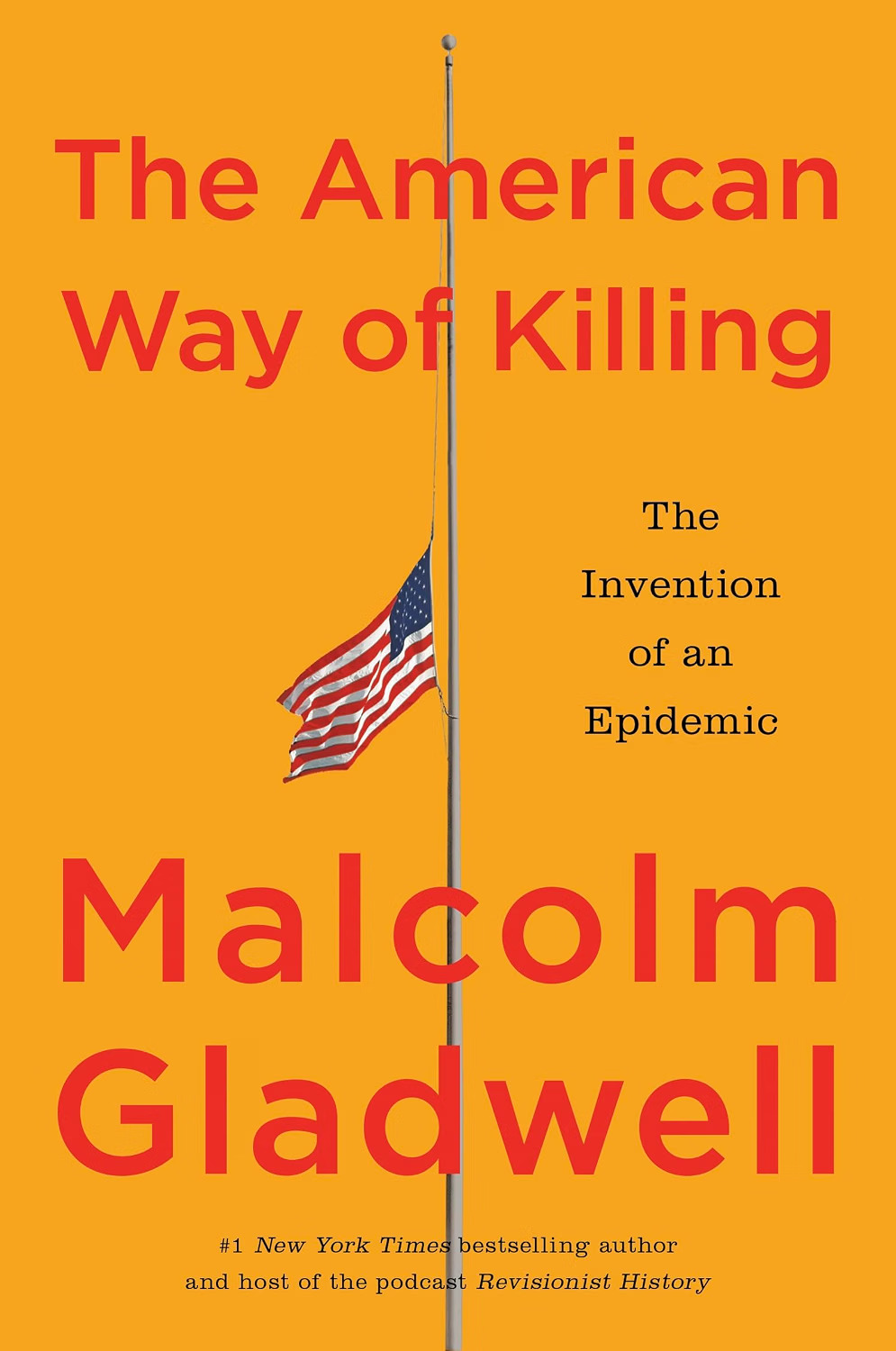
The American Way of Killing: The Invention of An Epidemic by Malcolm Gladwell. Published by Abacus, 285pp.

Share this article:

Subscribe to our newsletter to not miss articles like this one:
 SUBSCRIBE