

Written by:

Review: The Manson trial as history and spectacle
 Reading time: 6 minutes
Written by:
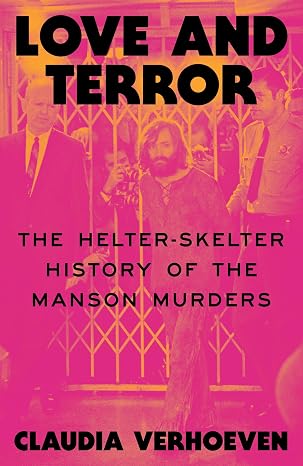
In August 1969, members of a counter-cultural family led by Charles Manson killed some of Hollywood’s ‘beautiful people’, and others living nearby. The killers left behind evidence intended by them to implicate Black radicals and to trigger an apocalyptic race war.
Dr Claudia Verhoeven, a modern historian, is aware that her book is yet another on the Manson murders. To prevent a ‘compulsive repetition’ of the extreme violence in the murders, she restricts descriptions of crime scenes to moments relevant to her narrative.
In its way that discretion is both sensitive in not dwelling overly long on the modes of death for the nine murders, with brutality, but also, regrettably, in not much of the specific behaviour by the family that constituted the capital crimes charged.
It is commendable that for such a famous set of crimes Dr Verhoeven presents an historiography of the subject-matter. Her reason is the ‘talented and tenacious’ researchers of these crimes produced limited work as it is ‘without … sources in scholarly apparatus’.
This narrative seeks to provide for the Manson cases a scholarly perspective, beyond only law, which has been, as she asserts, ‘more or less terra incognita’. Her sources include trial transcripts, to date not easily recoverable, for eight legal cases, amounting to 75,000 pages.
The book is not meant to be any kind of biography of Manson, but it is inevitable that he has to be considered in detail as he was at the centre of so much of what happened. The ‘family’ consisted of about thirty individuals, and there were more than a hundred associates.
The standard or ‘true’ story of the murders came to be told by Vincent Bugliosi, the prosecutor, and his version has had ‘incredible traction’ over the past half century. In any event, it was a lawyer’s narrative of the whole episode.
There are, according to Dr Verhoeven, few such infamous modern cases seen only from the prosecutorial perspective. There may be several reasons for that: principally, all the accused, it seems, declined to give evidence on oath in the main case.
There may of course be many such extreme cases now that are never seen from the prosecutorial case, simply because, in the United Kingdom, lawyers may take a different view of their role from that taken by American attorneys of theirs.
Helter Skelter, the term used by the family for ‘chaos’ or ‘confusion’, was the theory or motive by which Bugliosi ultimately made sense of the ‘bizarre’ murders, and significantly it appears, in his opening statement at the trial when everyone was looking for a lead.
The long version of the cause of Helter Skelter was references in the Bible, words from songs in a contemporary album by the Beatles, the coming war between Black and white citizens in America, and those who seemed likely to benefit from the whole matter.
Slowly with the passage of time and deaths of core participants, scholars have questioned, a view known as ‘Helter Skepticism’, the evidence in support of the concepts relied on by The People in their prosecution of those said to be responsible for several horrible deaths.
The description of the trial and the attorneys, deftly summarised by Dr Verhoeven, presents a legal world not known in the United Kingdom in 1969, and probably not even now. Some antics of Manson, amounting to ‘performance art’, would never be tolerated judicially here.
There seemed to be no specific defence in law put before the jury. Rather, the prosecution was in effect put to proof, and the evidence tested. For Manson, who did not participate in the notorious murders, the evidence was one of his having controlled or directed the others.
It is easy to see the inherent attractions for Manson: there were at least 60 accredited journalists in court, reporting the matter for the public. The public could hardly obtain a seat in the public benches; that was the subject of a, subsequently rejected, mistrial motion.
Legally, asserts the author, Manson was sane. At least one of his many lawyers sought to have Manson assessed by a court-appointed psychiatrist, and he was sacked for that. However, Manson’s medical condition, and his behaviour, appear throughout to have been unsettled.
It was not all ridiculous: one attorney died in an accident six months into what came to be a nine-month trial. A very good lawyer replaced the deceased one and represented the client ‘very ably’ despite facing 18,000 pages of transcripts, 400 exhibits and 1,200 documents.
Dr Verhoeven rewrites the Manson murders as a prism of American culture then, an event framed by global avant-gardist movements and revolutionary violence, and to that extent the trial is an early sign of the present age of the criminal trial as public spectacle.
The American view of Manson’s criminal trial is perhaps a dated one now. The trials then were not filmed or recorded or shown live online. The record of events is dependent on the memoirs of participants and an assessment of many newspaper and magazine accounts.
The press and public interest continued long after the trial and there are extensive discussions of the attempts of journalists, separately from medical people, to get at the truth, and whether and to what extent Manson had been involved in the deaths.
Dr Verhoeven concludes with a study of the concurrent trial by court martial of Lt. Wm. Calley, US Army, for the massacre by his platoon under his authority in Vietnam of many civilians, elderly people, women and children, who posed no obvious risk to the armed soldiers.
Comparing and contrasting the public and political attention directed unfavourably at Manson with that favourably to the army officer is both an education and a telling instance of the moral dilemmas that can arise from politicised but criminal activity in different spheres.
Doubtless Dr Verhoeven did other academic things while she was on her decade-long quest to place the Manson case in its true context in the developing subject of the history of crime. However, she has produced a superior narrative that goes beyond the endless retelling of the murderous activity itself in a dark era of modern American history.
Love and Terror: The Helter-Skelter History of the Manson Murders by Claudia Verhoeven, published by Verso, 376pp, £14.99

Share this article:

Subscribe to our newsletter to not miss articles like this one:
 SUBSCRIBE