Mercy Law warns of barriers to emergency accommodation as requests for help rise 23 per cent
 Reading time: 4 minutes
Mercy Law Resource Centre (MLRC) has reported a 23 per cent increase in people contacting its service after experiencing difficulties or unfair treatment when seeking emergency accommodation. The figures, published in its 2025 Annual Report, highlight the growing demand for legal assistance as Ireland’s housing and homelessness crisis worsens.
Uachtarán na hÉireann, President Catherine Connolly, will formally launch the Annual Report today, at the Wisdom Centre, Sophia Housing, Dublin 8.
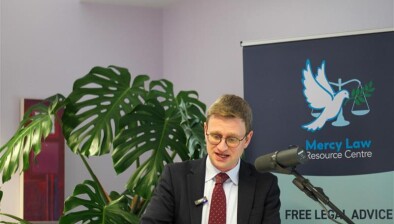
Managing solicitor of MLRC, Paul Dornan, said they were deeply honoured that President Connolly had accepted their invitation to attend and hear first-hand about their vital work with the most vulnerable people in our society.
The event will also launch a new MLRC report, Human Rights and the Public Sector Duty in Access to Social Housing and Homeless Services, supported by the Irish Human Rights and Equality Commission (IHREC). The report examines how public bodies can better fulfil their human rights and equality obligations when making decisions on housing and homelessness. It will be launched by IHREC Chief Commissioner Liam Herrick.
MLRC’s Annual Report outlines in stark detail the extent of difficulties individuals and families face when seeking emergency accommodation and social housing. During 2025, the Centre assisted 589 people through its legal information triage service and provided direct legal advice to 246 clients.
Among the cases highlighted is that of a family with six children who were given a local authority voucher worth €130 per night for 10 nights to secure emergency accommodation. Despite extensive efforts, the family could not find accommodation that would accept the voucher. Following legal intervention by MLRC, the local authority ultimately secured suitable accommodation for the family. This should have occurred without the need for representation by MLRC.
Other cases involved people forced to sleep in their cars, families fleeing domestic violence who were refused homeless support because they could not demonstrate a local connection, and people refused social housing without being given reasons for the decision.
MLRC also highlights the difficulties faced by victim-survivors of domestic and gender-based violence when leaving refuge accommodation. In one case involving a mother and young daughter facing discharge from a refuge and requiring further homeless supports, a local authority stated in writing that it did not have a direct role in providing accommodation for victims of domestic violence.
MLRC say these cases show the serious consequences of gaps in homelessness legislation and the considerable discretion afforded to local authorities which is resulting in inconsistent approaches to providing essential accommodation support.
Calls for stronger legal protections and access to justice
MLRC’s new report on the Public Sector Human Rights and Equality Duty examines how existing legal obligations could be more effectively applied to decisions affecting people experiencing homelessness.
The Irish Human Rights and Equality Commission Act 2014 states public bodies must consider human rights and equality when carrying out their functions. MLRC argues that these obligations must extend beyond strategic plans and be acted upon in everyday decisions about access to accommodation and housing supports, particularly for minority groups and people at greater risk of exclusion.
Commenting on the findings, Mr Dornan said: “Against the backdrop of ever-increasing numbers of families and individuals being recorded as homeless, MLRC is working hard to support those facing barriers when they need emergency accommodation or social housing supports. We are struggling to meet the demand for our services.
“For the second consecutive year, we have recorded a sharp increase in the number of people contacting us after experiencing difficulty or unfairness when seeking emergency accommodation, with a 23 per cent increase in 2025.
“Behind these figures are families fleeing domestic violence, people forced to sleep in their cars and individuals being denied access to essential housing supports. These are not isolated cases. They are problems we have encountered repeatedly over several years, and the continuing rise in homelessness is making the situation worse.
“Recent legislative changes risk creating further barriers, particularly for people from minority or excluded communities. Adequate funding for independent and community law centres, through a reformed civil legal aid system, is urgently needed to ensure that vulnerable people can assert their rights when seeking essential accommodation supports.”
MLRC is calling for civil legal aid reform, including adequate funding for independent and community law centres. It says that many people experiencing homelessness cannot afford private legal representation and that state-funded legal aid remains unavailable or inaccessible for many housing, homelessness and related social welfare matters.

Share this article:

Subscribe to our newsletter to not miss articles like this one:
 SUBSCRIBE