

Call for ‘presumption against contact’ in NI family court cases involving domestic abuse
 Reading time: 4 minutes
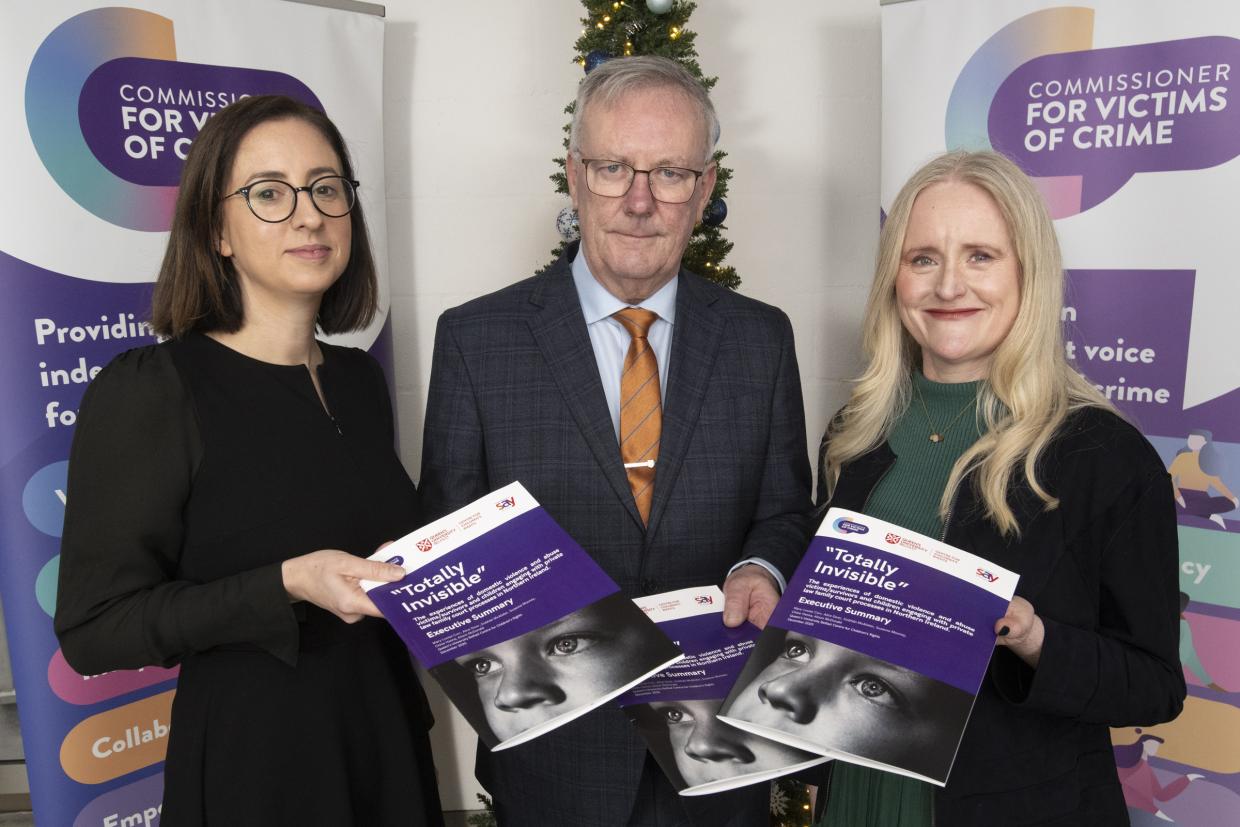
Northern Ireland’s family courts should apply a “presumption against contact” in cases involving domestic violence and abuse, a report has recommended.
The Totally Invisible report, produced by researchers in the Centre for Children’s Rights at Queen’s University Belfast, was launched this week by the commissioner-designate for victims of crime in Northern Ireland.
It examines the experiences of victims of domestic violence and abuse within the private law family court system and makes a number of recommendations for reform.
While there is no statutory presumption of contact in Northern Ireland, the researchers say their analysis “demonstrates an assumption of contact that operates in practice”.
They recommend the introduction of a presumption against contact, including indirect contact, in cases where domestic violence and abuse (DVA) is established.
The report also highlights a lack of understanding of domestic abuse dynamics among some professionals; an inconsistent application of safeguarding measures, leaving victims and children at risk of being harmed; and delays and complexity in proceedings, which can exacerbate trauma and prolong exposure to risk.
Geraldine Hanna, the commissioner-designate for victims of crime, said: “This is a pivotal moment to transform family courts into spaces of safety and justice.
“There is a better way, we can have a private family law system that truly serves the safety and well-being of domestic abuse victims and children in Northern Ireland.
“The courage of the victims who came forward to speak to the researchers is phenomenal, especially the young people involved. We owe it to them to make things better.
“One of the victims in this report described victims of domestic abuse as ‘totally invisible’ in our private law family court system. I hope this report is a first step in making those victims feel seen, heard and valued.”
Mary-Louise Corr, of the Centre for Children’s Rights at Queen’s University Belfast, added: “We are grateful to all those who came forward to contribute to this research to better understand the experiences of DVA victims/survivors and children engaging with private law family court processes in Northern Ireland.
“Our research shows that gaps in understanding shape experiences of the family court processes, particularly where experiences of domestic violence and abuse are disregarded and victims/survivors feel their fears and concerns have been dismissed.
“While professionals’ express commitment to children’s participation, current practices often fail to genuinely listen to children’s views, leading to a disconnect between professional understanding and children’s actual experiences.
“A presumption towards contact with an abusive parent also neglects to consider the multiple impacts of contact on children and their resident parent.
“Meaningful reform will require a decisive and adequately funded shift towards trauma-informed, victim/survivor and child-centred processes, grounded in an enhanced awareness of the cumulative impacts of DVA.”
The research has been welcomed by Northern Ireland’s justice and health ministers.
Naomi Long, the justice minister, said: “I am grateful to the commissioner-designate for carrying out this important piece of research and would also like to pay particular tribute to those service users, and the young people, who came forward and shared their experiences.
“I know from speaking to survivors of domestic abuse how difficult this can be. However, their voices are crucial in ensuring their interactions with the justice system do not add to their trauma but instead help them on their road to recovery.
“I am committed to improving the experience of domestic abuse survivors during family court proceedings and will work with my ministerial colleagues who share responsibilities in relation to family justice as we continue efforts to enhance and build upon the services already available.”
Health minister Mike Nesbitt added: “I would like to thank all of the participants who gave their time to take part in this important research, many of whom shared their lived personal experiences which, unfortunately, were not always positive.
“I recognise the significant courage it has taken to speak about such experiences, and I assure you that this contribution will inform learning and any future reform.
“My Department will take time now to consider the report’s findings and recommendations and how these can be taken forward in partnership with other government departments.”

Share this article:

Subscribe to our newsletter to not miss articles like this one:
 SUBSCRIBE