

Written by:

Review: Considering the evidence for UFO’s
 Reading time: 6 minutes
Written by:
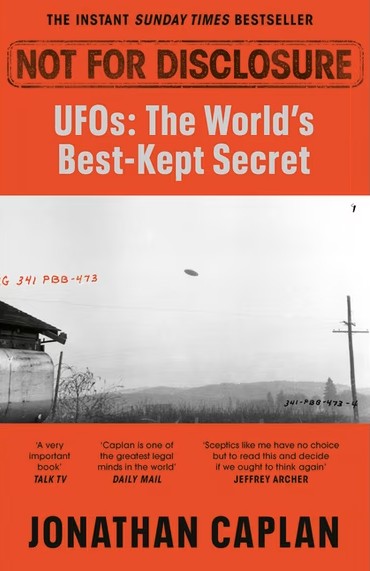
This book, according to the publishers, is the “most serious and sourced book ever published on the subject of UAPs (unidentified anomalous phenomena) by a world-leading authority”. It appears to be the outcome of a longtime interest in the subject.
The notes on the inside back cover, reveal the author is a King’s Counsel “and one of the UK’s premier barristers.” He has, in particular, “utilised his career experience to seek out the most reliable UAP evidence and to evaluate information from highly place contacts.”
The UAPs (unidentified anomalous phenomena) were first known as flying saucers before they were rebranded as UFOs (unidentified flying objects). The further change of name reflects the ‘fact’ that there is an increasingly complex range of phenomena and strange objects.
Proof is a well-established issue: the UAP topic is littered with frauds, those with an agenda, honest but mistaken witnesses, and those who are honest and probably not mistaken but whose testimony is uncorroborated. Evidence is either testimony or data, preferably both.
The learned author suggests that the high level of secrecy surrounding all aspects of UAPs was maintained by lies, ridicule, threats and, if necessary, the use of physical force. “Threats continue to this day”. Debunking the subject has been standard practice.
Less controversial reasons offered for secrecy are the political concerns that would follow an admission that ‘we’ are not in control even of our oceans, or airspace. The risk of panic, the damage to the financial markets and the loss of control by lawful authorities are all suggested.
For governments to say now what the truth is of all the events described would involve admitting that the public and ‘even constitutional assemblies’ had been misled for decades: ‘The history of this topic demonstrates a conspiracy and not just a conspiracy theory’.
Thus, for five decades, the author has been assembling an extraordinary body of evidence about the existence of UAPs, and what he believes to be the world’s greatest ever cover up. The range of official and anecdotal evidence is substantial and, in its way, impressive.
The study includes the evidence of documents from the US Government, intended for executive use, narrating the discovery of crashed non-human spacecraft, and “sometimes their biological occupants” and the consequential plans to preserve the evidence.
Mass sightings are an important aspect of the phenomenon: the greater the number the more likely the truth of the observations. There was a particularly detailed story from Zimbabwe in 1994 of a vivid object from the sky that landed from which one or two small men emerged.
Although 66 children claimed sightings, and the departure of the object, not all the people at the school then saw anything untoward. There have been subsequent suggestions of a hoax, or mass hysteria.
Public perception of the UAP issue changed radically in July 2023 when David Grusch, a former US Air Force intelligence officer, gave evidence on oath to a US Congress committee while on live television that the United States possessed a crashed non-human craft.
That short story appears in the chapter headed ‘A Constitutional Crisis’. It may well have been but the politics revealed then are illuminating. Briefings for Presidents, it seems, are on a ‘need to know basis’. Other Presidents had been told that they had ‘no current need to know’.
The US career intelligence officers involved in all this, allegedly, view even the most serious politicians as ‘temporary employees’ due to their limited tenure in office. What these ‘temps’ are told depends on the extent to which it is thought that they can be trusted.
It is weird, frankly, to go from profound issues of accountability, as a matter of constitutional law, to further anecdotes about JF Kennedy being assassinated when President because he was about to give away to the Russians the vital secret that ‘aliens’ were present in America.
However, Caplan explains the shifting facts around the act of assassination and the reasons for it. More particularly, it is asserted by him that evidence exists that shows that lowering the risk of nuclear war by openness with the Soviets about UAPs was a better explanation.
Not all the anecdotes in support of a general thesis can be said to be repetitive. The facts and circumstances of the death of Marilyn Monroe is well-known, and less so are those of her friend Dorothy Kilgallen which were eerily similar and inexplicable. Both knew about UAPs.
Caplan argues that disclosure by governments must come about someday. It is necessary to know what governments have suppressed, and to correct the injustice perpetrated on those who have had profound UAP experiences and been ignored or discredited unfairly.
Any reader will reach their own view on the substance of the many incidents on which Caplan sustains his narrative. It might be suggested, for example, that like does not always seem to be compared with like. Many of the incidents are described very superficially.
The vast number of incidents relied on are from America where social and other conditions might be conducive to phenomena being reported. Also, the coincidence of events one after the other does not necessarily amount to a cause and effect.
There is no bibliography, as such, but the author lists many textbooks in his notes to each chapter. The literature is very extensive and it is really a matter of personal assessment as to whether a reader takes the UAP experiences seriously; it is certain that many people do so.
Not For Discussion: UFOs: The World’s Best Kept Secret by Jonathan Caplan, published by London: Century Books, 274pp, £17.99

Share this article:

Subscribe to our newsletter to not miss articles like this one:
 SUBSCRIBE