



Quarter of financial services professionals fear Irish economic contraction in 2026
 Reading time: 4 minutes

Liam Flynn and Rowena Fitzgerald
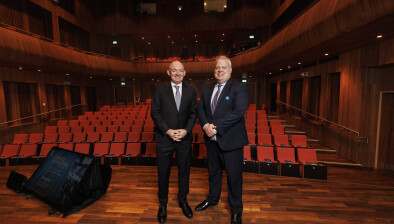
One in four financial services professionals believe Ireland faces a risk of economic contraction in 2026, according to almost 400 attendees at Mason Hayes & Curran’s annual Financial Services Briefing.
Forty-four per cent expect modest growth, while 31 per cent anticipate a flat performance.
Rowena Fitzgerald, partner and co-head of financial regulation, said: “Firms are dealing with a more uncertain environment than at any point in recent years. Middle East conflict and higher energy costs are adding to that pressure. The Central Bank’s 2026 outlook makes it clear that risks that once seemed remote have become more likely. We are seeing clients pressure-test their assumptions and plan for faster changes in conditions. The question for boards is no longer if things will change, but how fast and how prepared they are when they do.”
Four in ten respondents identified competitive pressure as their firm’s biggest growth challenge this year. One third pointed to regulatory change, followed by operational capacity at 27 per cent. Firms are currently preparing for a significant wave of incoming legislation, including new banking reform measures, updated consumer credit rules, a revised payments services directive and a new EU-wide anti-money laundering rulebook, with further measures in the pipeline.
Liam Flynn, partner and co-head of financial regulation, commented: “The number of licensed banks and insurers in Ireland has fallen over the last ten years, even as total assets have grown. Fewer firms are sharing a larger market. Despite years of industry calls for simplification, the volume of incoming regulation has not reduced. And while Ireland has made progress in attracting payments and fintech firms, we have taken a very cautious approach to crypto and digital assets. We have ten crypto firms licensed here compared to over twenty in the Netherlands and fifty in Germany. Other markets are moving faster, and that is something Ireland needs to reckon with.”
The pace of consolidation in the market is accelerating, with two recent high-profile transactions reflecting a global shift towards fewer but larger, more capitalised players. The agreed acquisition of PTSB by Austria’s BAWAG Group ends the State’s last remaining crisis-era bank shareholding. In insurance, Zurich’s acquisition of Generali’s Irish general insurance business, sold under the RedClick brand, further concentrates the market.
Geopolitical developments are also increasing complexity for firms operating across borders, particularly in areas such as sanctions and capital markets activity. Recent enforcement action involving Irish-linked entities has brought renewed focus to how these risks arise in practice, including through supply chains and cross-border payments.
Daragh O’Shea, partner and head of debt capital markets, structured finance & derivatives at the firm, added: “Sanctions compliance is a key operational risk for firms, especially those with international exposure. Irish companies need to increase awareness of how that risk can arise in practice, particularly where activity crosses jurisdictions. We are working with clients to review counterparties and strengthen oversight so risks are identified early. The focus is on putting clear processes in place so firms can respond quickly when rules change.”
Cost reduction was identified as the primary driver of consolidation in the sector by 37 per cent of respondents, followed by market competition (32 per cent) and artificial intelligence (31 per cent). The results suggest firms are using consolidation to manage cost, while also investing more selectively in AI to support efficiency and delivery.
Irene Nic Chárthaigh, financial services partner, said: “In Ireland, non-bank lenders now account for roughly 30 per cent, a significant share of new SME lending, making private credit a core systemic pillar of our domestic financing. Recently there has been a trend towards consolidation in this space as firms deal with cost and competitive pressure.”

Share this article:

Subscribe to our newsletter to not miss articles like this one:
 SUBSCRIBE