
Lewis Silkin: Ten things your lawyer wants you to know about AI
 Reading time: 6 minutes
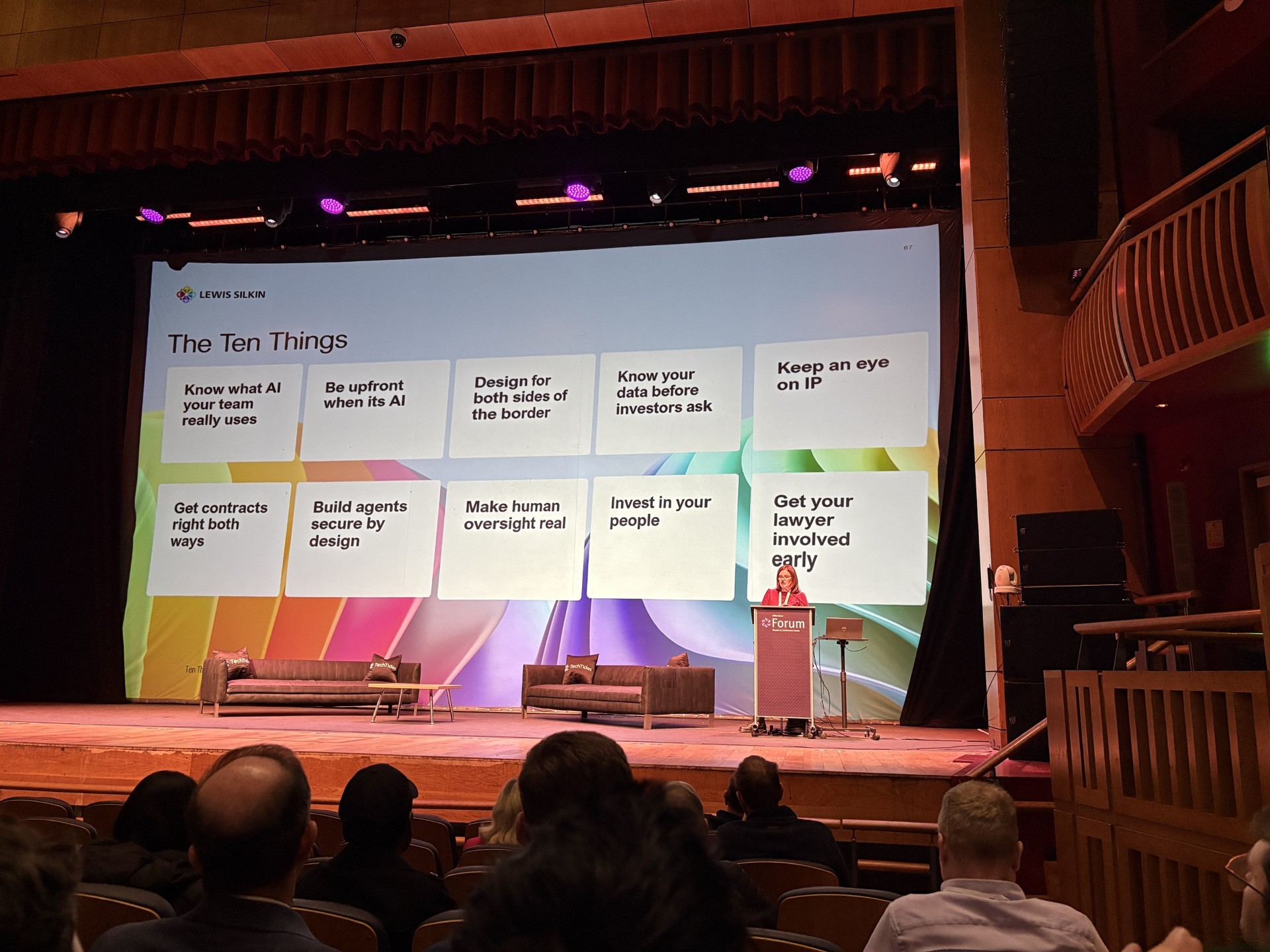
Caroline McNally presenting at TechTides
Northern Ireland businesses embracing AI should put legal safeguards, clear policies and meaningful human oversight at the heart of their approach, according to Lewis Silkin. Speaking at TechTides in Derry Londonderry, the firm outlined ten key considerations for responsible AI adoption, from transparency, data protection and intellectual property to contracts, investment readiness and navigating UK and EU rules. Its central message: involve legal advisers early, train staff properly and establish clear accountability to make the most of AI’s opportunities while managing its risks.
AI presents opportunities but also challenges for businesses across Northern Ireland. 61 percent of Northern Ireland workers use generative AI at work, and nearly a third do so without their employer knowing (Deloitte GenAI Workforce Survey 2026), exposing businesses to data leaks, IP risks and unchecked output.
Research also shows that NI businesses are taking a measured, human-centred approach to AI, with the 2026 AICC Census showing just 6 per cent of NI businesses using AI to automate or replace roles (the lowest of any UK region) and 43 per cent training or retraining staff for AI.
At TechTides in Derry Londonderry last week Lewis Silkin’s Caroline McNally spoke on the ten things your lawyer wants you to know about AI.
Caroline McNally, legal director in the commercial and technology team, said: “We all know how impactful AI can be with the likes of improved efficiency or automation, but it comes with legal implications as well. That’s why we’ve set out ten key things that as lawyers we want businesses to know when it comes to AI.”
Firstly, it’s that your team is already using AI. Research from Deloitte GenAI Workforce Survey 2026 suggests that 61 per cent of NI workers use generative AI at work, and nearly a third without their employer knowing. Lewis Silkin suggests having approved tools and policies in place to avoid the risk of data leaks, IP exposure and unchecked output by shadow AI.
Second is to be upfront about AI usage. Ulster University’s AI Pulse survey from December 2025 indicated that three quarters of respondents disagree that they can trust AI to be used ethically. Lewis Silkin’s advice is to label any AI-generated content and be honest with customers or suppliers when AI is involved.
The third is regarding Northern Ireland businesses selling into the EU, sharing data across the border or employing people in both Northern Ireland and the Republic of Ireland that may need to meet EU rules, including the EU AI Act, as well as UK law. From the outset, businesses should design for both regimes, rather than needing to retrofit at a later stage.
Katey Dixon, partner in Lewis Silkin Belfast office, explained the fourth item which is around investment: “If your business is seeking investment or you are planning for a future sale, it is essential to understand the provenance of the data, technology and other assets that underpin your operations. AI, technology and data are now key areas of focus in investment and acquisition due diligence, making it critical to know exactly where your data comes from, how it is used, and what rights you have to it.”
Fifth on the list is intellectual property (IP) and the use of AI content. The IP rules are still being written, so the advice from Lewis Silkin is to train AI only on material you own, material licensed for that specific use or material you have agreed a licence for. And if you want to own what the AI produces, add your own creative input.
Contract is the subject of the sixth thing your lawyer wants you to know. The team at Lewis Silkin say that your contract should reflect how you actually use AI, for your customers that’s outputs, data use, suspension and rollback, for suppliers it’s liability caps, data used for training and pricing and it also should include continuity and exits. In the UK there is no AI-specific liability regime, so the contents of the contract are vital for protection.
Seventh is on AI agents and their need to be secure and accountable by design. When an AI agent acts on its own, liability doesn’t disappear. The Lewis Silkin team has some advice around AI agents which includes only giving the agent the access or information it needs, continuing to test it after it goes live, and “red teaming” it by trying to trick it into acting outside its authority.
Emma Grossmith, managing associate in the employment team at Lewis Silkin, detailed the eighth and ninth items on the list, which involve human oversight and training: “When it comes to AI, human oversight has to be real and ongoing. For NI businesses, it’s important to remember that Northern Ireland has its own equalities law which can differ from those in the rest of the UK. These laws still apply when AI is used in recruitment and other decisions about people. AI presents a great opportunity, especially for HR professionals and in the hiring process, but the importance of human oversight must not be overlooked.
“Training must go beyond the basics. It should cover when not to use AI tools, and importantly, what data can and can’t go into AI tools. As mentioned in one of the earlier points, it’s imperative that there are parameters set around what tools can be used, but there must also be policy on how to use them and staff need to be properly trained on those rules.”
Finally, your lawyer wants to help. Include your legal team from the outset to be ready for the opportunities and challenges that AI poses.
Caroline McNally added: “AI tools that are adopted ethically, appropriately, and within the parameters of the law can address real problems, deliver measurable outcomes and reward organisations that experiment, govern and scale effectively. Northern Ireland is positioned to lead in trusted, secure and practical AI adoption through collaboration, cyber strengths and practical innovation, but businesses need to put the right governance around AI from the start.”


Share this article:

Subscribe to our newsletter to not miss articles like this one:
 SUBSCRIBE