



Jessica Ní Mhainín: An ongoing legal action raises serious concerns about the lack of anti-SLAPP protections in Northern Ireland
 Reading time: 8 minutes
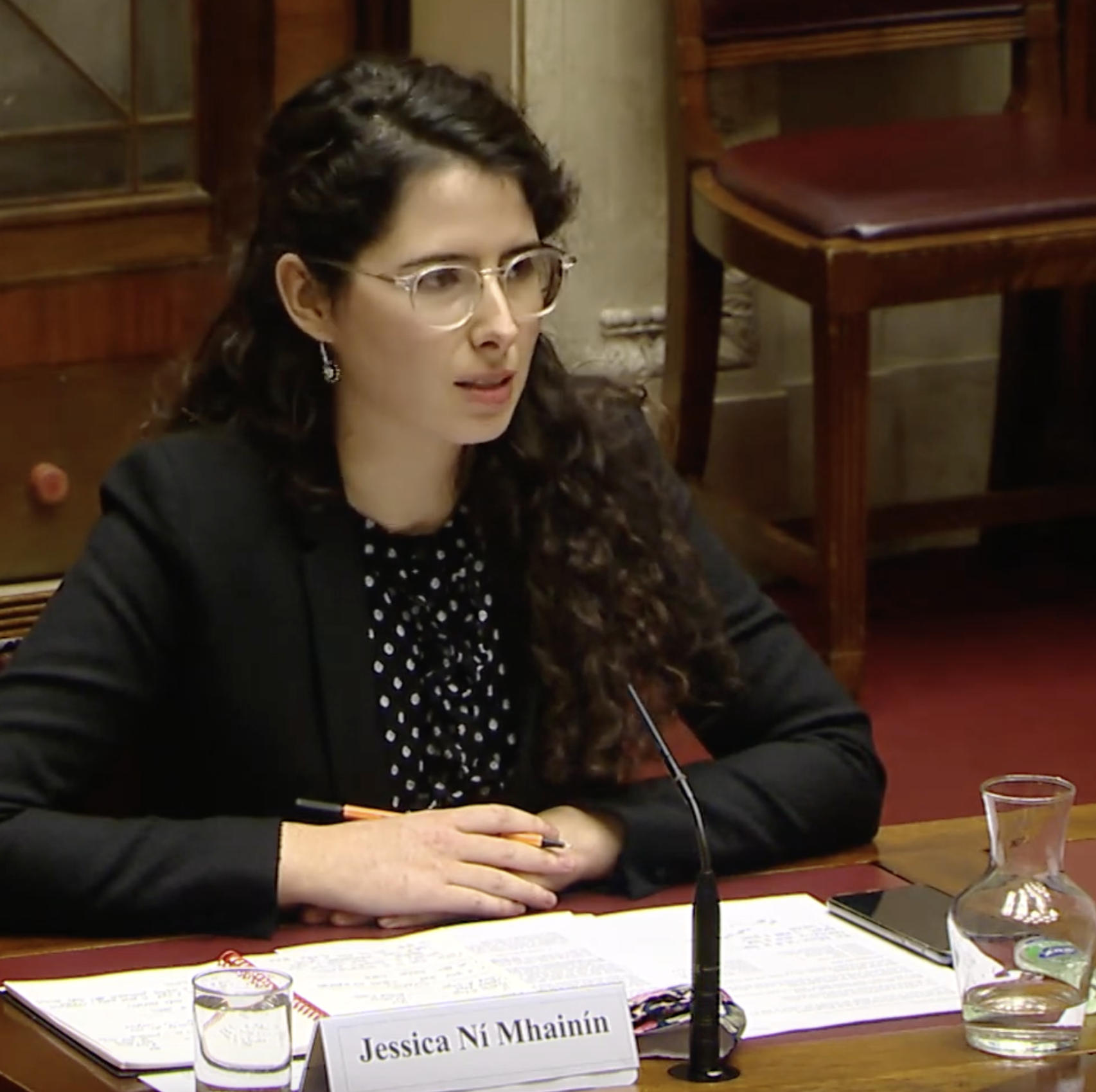
Jessica Ní Mhainín
There is something deeply concerning about the idea of an academic and environmental campaigner facing defamation proceedings from a billion-pound company over comments made while discussing his environmental campaign on a university podcast. Yet, that is the position that Professor Geraint Ellis of Queen’s University Belfast (QUB) currently finds himself.
Ellis, a professor of environmental planning, appeared before the Royal Courts of Justice in Belfast last month as his legal team sought to have the proceedings struck out.
The action arises from two episodes of QUB’s podcast Solastalgia: Stories of Accidental Environmental Activism in Northern Ireland, published in 2023. Ellis appeared alongside another environmental campaigner to discuss their opposition to proposals for an oil terminal and distribution depot in Whitehead, County Antrim. Both were members of the Stop Whitehead Oil Terminal (SWOT) campaign at the time.
Now two directors of LCC Group Ltd, the company behind the proposed development, are claiming that they were defamed on the podcast. Both claimants are members of the Loughran family, one of Northern Ireland’s wealthiest, with a reported net worth of £770 million. They are taking legal action against Ellis, as well as QUB and Ellis’ co-contributor on the podcast (who is a fellow campaigner). Ellis was the only defendant represented at the court hearing on 29 September.
Those of you who are familiar with the concept of a strategic lawsuit against public participation (SLAPP) may already have started to notice certain details; the fact that the legal action targets an act of public participation, the clear financial advantage that the litigant has over the defendant, and the fact that there are three separate defendants for the same publication – two of whom are individual campaigners.
For those less familiar with SLAPPs, these are among the “indicators” set out in the Recommendation on countering the use of SLAPPs, a set of standards passed by the Council of Europe (COE) in April 2024 and applicable to all 26 member states – including Ireland and the UK. The intention of the COE Recommendation is to guide member states on how to handle cases of abusive litigation, including by providing a definition to support the identification of SLAPPs.
SLAPPs, the Recommendation explains, are legal actions that are “threatened, initiated or pursued as a means of harassing or intimidating their target, and which seek to prevent, inhibit, restrict or penalise free expression on matters of public interest and the exercise of rights associated with public participation.”
It goes on to list “indicators”; details that may suggest if a case is being pursued abusively. Not all of the indicators have to be present in a legal action in order for it to be considered a SLAPP but, as the Recommendation says, “the more of them that are present or the more acute the behaviour, the more likely the legal action can be considered as a SLAPP.”
And, as attendees in court in September will have heard, there are a number of SLAPP indicators present in the case against Ellis.
“There is no meat on the bones,” Ellis’ counsel argued in court, referring to what they said was a lack of substance in the case. The defamatory statements allegedly made by Ellis were never properly identified in the litigation, they said, leaving Ellis and his legal team to guess which words were the subject of the claim.
During the hearing though, counsel for the claimants clarified what statements were allegedly defamatory. They said that Ellis had defamed the company by accusing it of “destroying the planet”. They also argued that his characterisation of LCC’s purchase of an East Belfast film studio as “greenwashing” was equivalent to an accusation of money laundering. (An equivalence that was immediately contested by the judge).
The alleged defamatory statements, combined with the minimal reach of the two podcast episodes – 10 and 12 listeners respectively, according to counsel for Ellis – certainly makes it seem like the claim for “special, aggravated, and exemplary damages” is disproportionate.
The Council of Europe Recommendation counts a “public relations offensive designed to bully, discredit or intimidate actors participating in public debate” as a SLAPP indicator. We are not aware of any public relations offensive against Ellis. The court heard that Ellis had been subject to surveillance by LCC Group, as indicated by its response to a data subject access request submitted by Ellis. Counsel for the Loughrans did not comment on the allegation of surveillance during the court hearing, but discovering that you have been subject to surveillance is bound to be an intimidating experience.
During the hearing, the judge asked Ellis’ legal team why they believed the academic and campaigner was facing legal action. The court heard that Ellis is one of the leaders of the SWOT campaign, which had challenged the decision to grant planning permission to LCC Group in 2024 through a successful judicial review.
Ellis’ legal team said that the proceedings could be interpreted as an attempt to pressure him to withdraw from campaign activities. The court heard that Ellis’ co-contributor to the podcast, who had also been subjected to legal action, had already left the campaign. In court, counsel for the Loughrans refused to engage with the suggestion that the case was being taken against Ellis in order to chill his campaigning efforts.
The UK Anti-SLAPP Coalition has contacted the solicitor for LCC Group and the Loughrans for comment who provided no comment by the time of publication.
This case is not the first time the Northern Ireland courts have considered the issue of SLAPPs. In January 2024, the same judge - Master Evan Bell - struck out defamation proceedings in Kelly v O’Doherty. In his judgment, he said that the case against journalist Malachi O’Doherty bore “the hallmarks of a SLAPP”, having been initiated “not for the genuine purposes of vindicating a reputation injured by defamatory statements, but rather for the purpose of stifling the voices of his troublesome critics”. It was the first time a UK court had found that legal proceedings bore the hallmarks of a SLAPP.
It could be the end of November before Ellis learns whether his application to have the proceedings struck out has succeeded. Until then, the case hangs over him. Whatever the eventual outcome, the risk of litigation may also give pause to others considering whether to speak out against environmental issues involving deep-pocketed companies.
That possibility is particularly troubling given the environmental stakes. Northern Ireland has in recent years been dubbed the “dirty corner of Europe”, while polling data released by the Northern Ireland Statistics and Research Agency earlier this year found that 73 per cent of people were “very or fairly concerned” about the environment.
Surely many of those people will be concerned about LCC Group’s proposed project in Whitehead given that it has the potential to account for as much as 63 per cent of Northern Ireland’s carbon budget by 2040. That figure comes from LCC’s own environmental statement.
Public participation depends on people being able to question, criticise and challenge decisions that affect their communities and their environment. If the prospect of costly litigation deters people from doing so, the consequences are not confined to the individual facing proceedings: public debate itself is diminished.
Certainly, freedom of expression will be in a sorry state if people cannot accuse fossil fuel companies of damaging the planet or cannot call them out on potential attempts to greenwash their activities.
Defamation law exists to protect reputation, and anyone who believes they have been defamed is fully entitled to seek redress through the courts. But there is a crucial distinction between pursuing a legitimate claim to protect one’s good name and using litigation to burden, intimidate or silence someone who is participating in a matter of public interest.
In 2024, the Northern Ireland Executive indicated that it was open to considering anti-SLAPP legislation in the short term and would monitor developments in Dublin and London in the meantime. Since then, both Dublin and London have taken steps towards addressing SLAPPs and both are currently considering standalone anti-SLAPP legislation.
Northern Ireland should follow suit. Stormont should implement the recommendations set out by the Council of Europe without further delay, including by enacting a standalone anti-SLAPP law.
We must wait for at least a few more weeks until we hear the outcome of the case against Ellis. But the issue of addressing SLAPPs has waited long enough already. We must take action to protect public watchdogs, to protect our right to freedom of expression and public participation, and to protect our democracy.

Share this article:

Subscribe to our newsletter to not miss articles like this one:
 SUBSCRIBE