



Fieldfisher identifies challenges in Irish battery storage market
 Reading time: 5 minutes

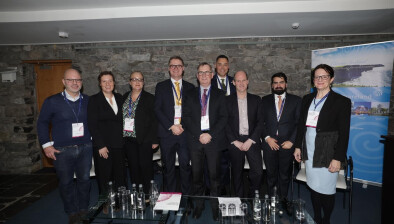
Pictured: Fieldfisher partners Elaine Traynor and Feilim O’Caoimh.
Europe’s battery energy storage sector is increasingly facing regulatory and grid‑access barriers after 18 months of unprecedented expansion, according to new analysis from Fieldfisher.
The European law firm’s latest report focuses on the European Battery Energy Storage System (BESS) economy across countries including Ireland.
The conflict in the Middle East is expected to accelerate demand for clean energy, boosting demand for BESS capacity while adding strain to supply chains and intensifying grid-connection and permitting pressures.
Europe’s large-scale battery storage capacity is set to increase more than sixfold by 2030, to more than 100 GW, but the report cautions that this progress depends on accelerated grid upgrades, simplified planning processes and clearer, more predictable and reliable legal frameworks for investors and developers.
Fieldfisher’s analysis spans 11 key European markets, supported by its BESS Market Maturity Index, which assesses countries across five legal and regulatory pillars: regulation, grid connection, investor confidence, incentives and cybersecurity.
The report finds that nine out of 11 markets already face saturated grids, resulting in long waits for connection approvals and increasing uncertainty around project viability.
Germany’s situation is the most acute: transmission operators received 226 GW of new grid‑connection requests in early 2025, far exceeding available capacity, with one grid operator confirming no further capacity until 2029.
However, Ireland faces similar constraints, operating just 730 MW out of a 10 GW pipeline due to grid readiness issues.
The report describes how grid operators are dealing with those challenges and describes opportunities resulting from the current situation.
Feilim O’Caoimh, co‑head of Fieldfisher’s energy, natural resources and sustainability group, said: “Developers need to move quickly to secure grid access in places where the connection rules are more flexible.
“From a revenue perspective, it is crucial to determine whether project‑finance structures will be required. If so, mechanisms such as revenue floors, tolling arrangements, or long‑term capacity contracts may be necessary. If not, revenue opportunities may instead be optimised through more flexible market‑based commercial arrangements.
“With rules changing across Europe, it’s important to build strong change‑of‑law protections into every project. Planning ahead on cybersecurity and fire safety will help avoid delays.
“And co‑locating batteries with renewable projects or data centres is one of the simplest ways to earn more, cut curtailment and build stronger, more reliable projects.”
Belgium and the Netherlands have introduced flexible access schemes to cope with congestion, while Spain faces rising curtailment as renewable penetration accelerates. These mounting pressures highlight the need for systemic grid reform across Europe, Fieldfisher says.
Permitting delays remain one of Europe’s most pressing challenges. In Austria, Germany and Ireland, planning and environmental approvals routinely exceed EU‑recommended timelines, with additional fire‑safety and environmental assessments further prolonging development.
By contrast, Portugal has adopted Europe’s most efficient reforms, fast‑tracking co‑located battery projects and cutting approval times by up to 40 per cent, supported by a stable legal framework and grant funding for more than 500 MW of capacity.
Daniel Marhewka, co-head of Fieldfisher’s energy, natural resources and sustainability group, said: “Investors want to support Europe’s storage build‑out, but they need certainty. Clearer planning timelines, transparent grid‑connection rules and consistent compliance requirements would unlock billions in private investment.
“The legal framework providing transparency for and supporting the commercial case is now essential in getting projects over the line.”
Ireland has one of the most constrained BESS markets in Europe, according to the law firm, with just 1.2 GW of battery energy storage live from a pipeline exceeding 10 GW – representing what the firm describes as a disconnect between policy ambition and delivery.
According to Fieldfisher’s analysis, grid congestion and connection delays remain the single biggest barrier.
While the Irish government has committed €3.5 billion in grid investment between 2026 and 2030, and EirGrid is progressing upgrades under Shaping Our Electricity Future and PR6, storage developers continue to face long lead times between planning consent and energisation.
Mr O’Caoimh said: “Ireland has a deeper and more bankable pipeline of battery storage projects than many European markets, but delivery now depends on how quickly projects can secure grid access and adapt to regulatory change.
“Storage will be central to integrating offshore wind, managing congestion and improving system resilience over the next decade.”
Elaine Traynor, renewable energy partner at Fieldfisher Ireland, added: “Whilst Ireland has a strong development pipeline of BESS projects, the implementation of these projects continues to be constrained by issues relating to route to market challenges and grid connection delays and congestion.”
From a commercial perspective, the report concludes that Ireland’s next phase of battery deployment will be shaped by market reform rather than subsidy alone.
The proposed implementation of long‑duration energy storage procurement policy, alongside the transition from DS3 to FASS, is expected to deliver clearer price signals and more sophisticated revenue stacking opportunities across capacity, system services and arbitrage.
The report finds that the next 18 months will be decisive: PR6 reinforcements, long‑duration auctions and the rollout of FASS will determine whether battery storage remains largely stuck in the development pipeline, or becomes a backbone asset of Ireland’s future electricity system.

Share this article:

Subscribe to our newsletter to not miss articles like this one:
 SUBSCRIBE