



Courts must shape how AI is used in justice system, experts tell Irish Judicial Studies Network launch
 Reading time: 4 minutes
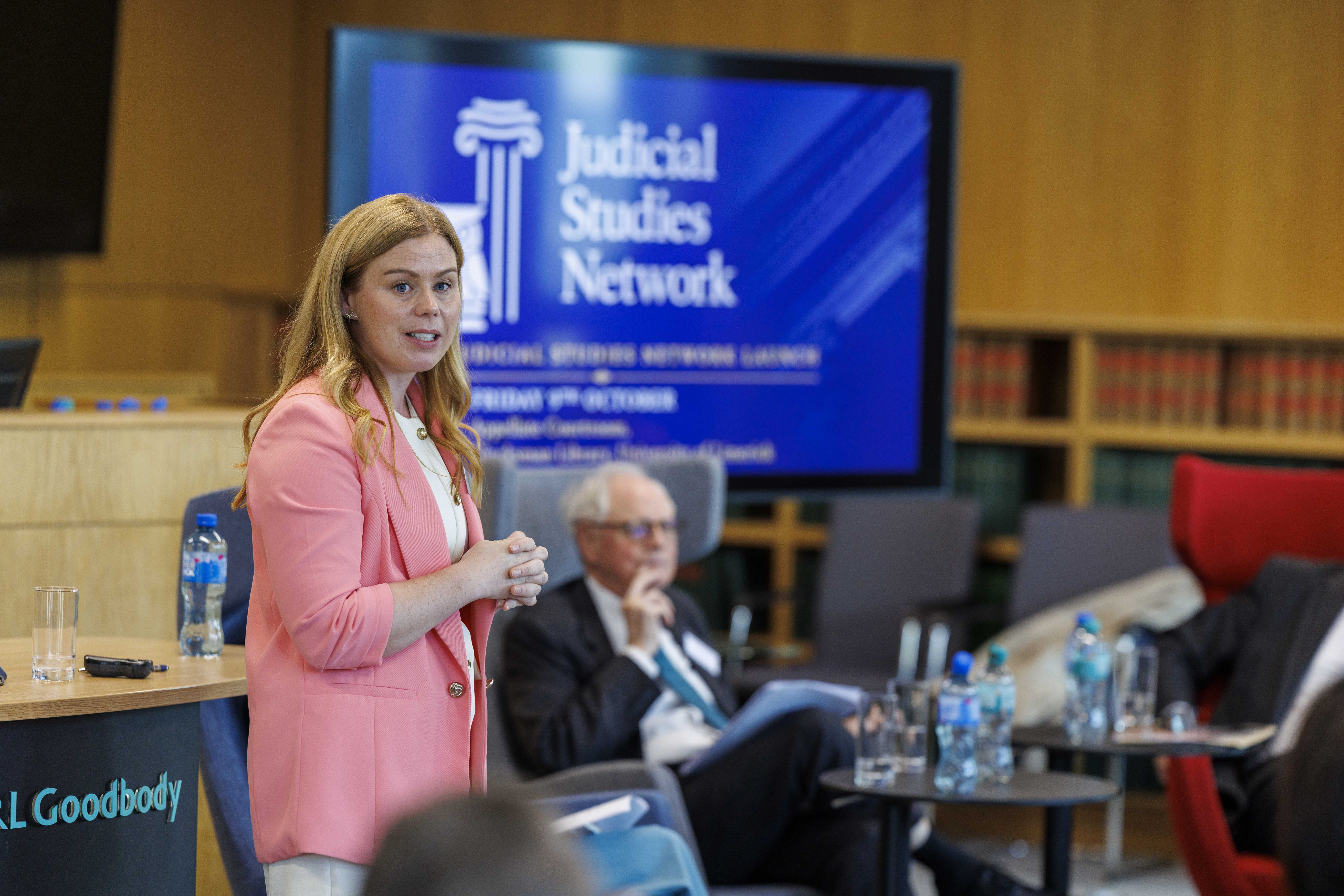
Professor Laura Cahillane, Chair of the Irish Judicial Studies Network, speaking at the launch at University of Limerick.
Credit: Arthur Ellis
The courts and judiciary must play a central role in shaping how artificial intelligence (AI) is used in legal systems if public trust and legitimacy are to be maintained, experts stressed at an event hosted by University of Limerick.
The issue was explored during a panel discussion entitled ‘Judging in the Age of AI’, which brought together legal scholars and researchers to examine the opportunities and challenges AI presents for courts, judges and the administration of justice.
The discussion formed part of the launch of the Irish Judicial Studies Network on 9 October 2026, the first dedicated network in Ireland focused on the study of judges, courts, and judicial decision-making, led by Professor Laura Cahillane from University of Limerick’s (UL) School of Law.
Panellists highlighted both the potential benefits and risks of AI in legal settings, including concerns around transparency, accountability, bias, deepfake evidence, and public confidence in judicial processes, at a time when governments and justice systems internationally are grappling with the rapid emergence of generative AI tools.
Professor Brian Barry of Trinity College Dublin argued that the key issue is not whether AI will enter the justice system, but who will shape its development.
“The question is whether the AI people meet in the judicial system has been shaped by the courts, developed with judges, and benchmarked against legitimacy,” he said.
Professor Barry asserted that AI could be used to help judges slow down decision-making, identify potential biases, and focus on key issues.
“Humans make errors, including judges. We all suffer from cognitive frailties and biases. The question is whether AI tools could be used to help judges engage in more deliberative thinking rather than instinctive thinking,” he said.
Katie Fleming, a PhD researcher at UL’s School of Law, said AI should assist rather than replace judicial reasoning and stressed that judges must remain accountable for their decisions.
She also highlighted the importance of transparency, arguing that any judicial reliance on AI should be clearly disclosed to maintain public trust in the courts.
“Judges remain responsible for their decisions,” she said, adding: “If there’s going to be judicial reliance on AI, it has to be disclosed.”
The event’s keynote speaker, Professor Gabrielle Appleby of the University of New South Wales, one of the world’s leading judicial studies scholars, said developments such as AI, judicial governance, and changing public expectations are transforming the environment in which courts operate.
“The benefits of having organisational structures through which the judiciary, academy, and legal profession can come together to reflect on contemporary challenges in relation to the judiciary is invaluable,” Professor Appleby said.
She described Ireland as being at a particularly important moment in the development of its judicial institutions.
“Ireland is not simply debating judicial institutions. It is building them. That creates an extraordinary opportunity to study, almost from their inception, how those institutions actually work.”
During a closing discussion with Professor Gabrielle Appleby and Professor Ross Cranston of the London School of Economics, Chief Justice Donal O’Donnell reflected on the importance of engagement between the judiciary and legal scholars, welcoming opportunities for dialogue created through initiatives such as the Irish Judicial Studies Network.
“I’ve always been a big supporter of interaction between the judiciary and scholars,” he said, adding that “there’s an enormous amount to gain from that interaction.”
The event marked the formal establishment of the Irish Judicial Studies Network, a new initiative that will advance research, teaching, and policy engagement on and with the judiciary.
Chair of the Network, Professor Laura Cahillane said the initiative comes at a time when understanding how courts function is increasingly important.
“While judges and courts have always occupied a central place within our constitutional framework, the systematic study of the judiciary as an institution is still a relatively young field of academic inquiry,” said Professor Cahillane.
“At a time when public confidence in democratic institutions is more important than ever, it is essential that we continue to deepen our understanding of the judiciary and its role within our constitutional order.”
Professor Cahillane explained that the Network will bring together researchers, judges, legal practitioners, policymakers, and students to foster research, informed policy discussion, and interdisciplinary collaboration.
The initiative builds on UL School of Law’s long-standing relationship with the judiciary, including its role in producing the Irish Judicial Studies Journal.
Professor Cahillane said the Network would help ensure that academic research can contribute to real-world policy discussions on the future of the courts, access to justice and judicial reform.

Share this article:

Subscribe to our newsletter to not miss articles like this one:
 SUBSCRIBE