

Written by:

Our Legal Heritage: An horrific baby poisoning and a ‘not proven’ verdict too close to home
 Reading time: 5 minutes
Written by:
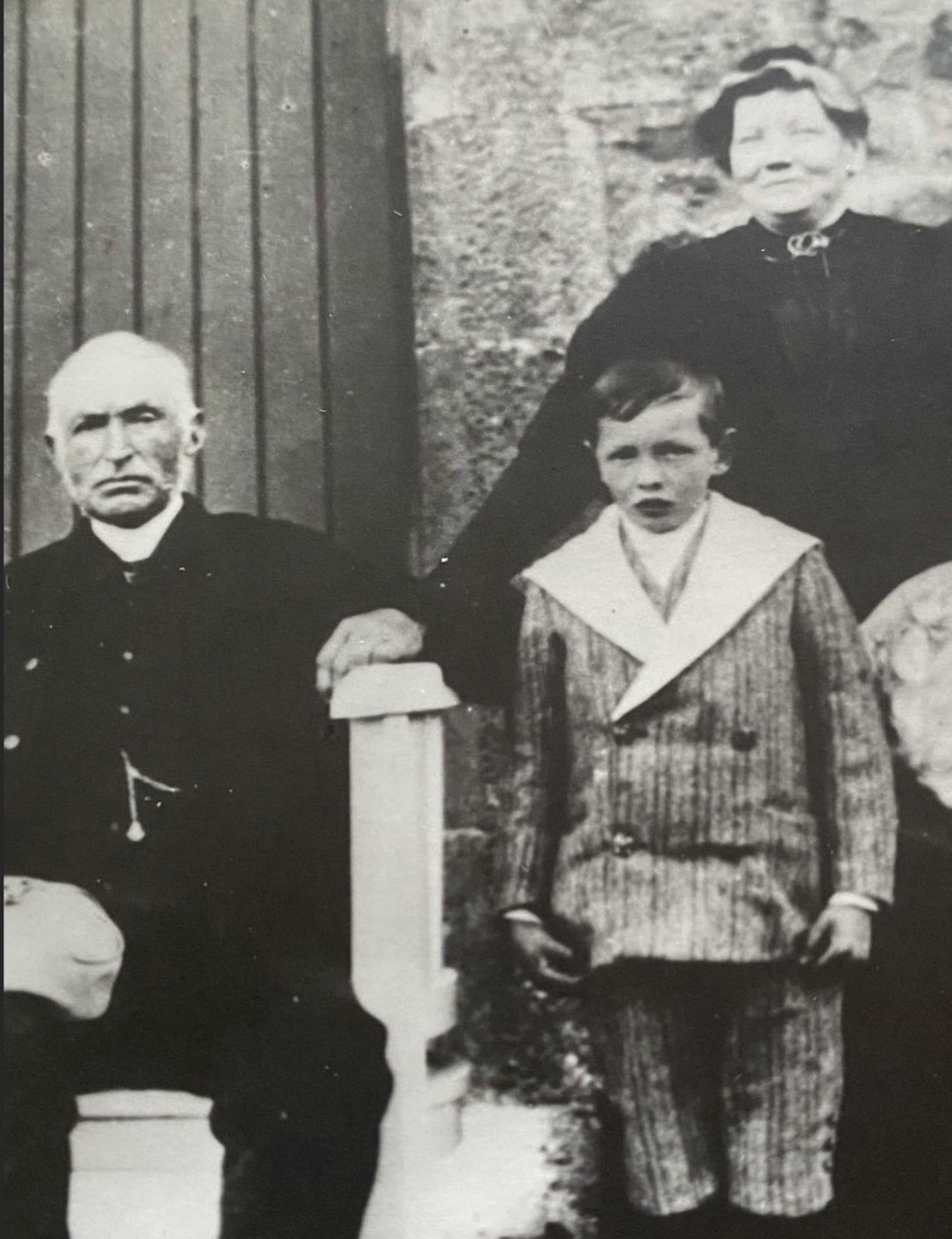
Stewart Ogilvy (left)
Until last year, I never took an interest in my Ogilvy ancestors, and I wish I had left it that way. Farmers at the head of Glenisla for hundreds of years, they were tenants and kinsmen of the Earl of Airlie. In contrast to my English relations (war heroes and concentration camp survivors), they seemed boring and predictable.
But last year I was surprised to come across a press cutting reporting how my great-grandfather, Stewart Ogilvy, had purchased the stock and goods of his late brother David at a roup at the family farm in 1885. In the report, he was described as ‘a flesher of Dundee’. My interest was piqued, and a search of the British Newspaper Archive produced a shocking revelation.
In 1869, a Stewart Ogilvy was on trial at the High Court in Dundee charged with murder. It got worse, a lot worse. His alleged victim was a three-week-old baby boy and, incredibly, the indictment accused him of administering sulphuric acid to the unfortunate child. It was a crime so horrific as to be scarcely believable. Could there be two Stewart Ogilvys? Alas, research by legal historian Robert Shiels confirmed that the 25-year-old on trial had been born in Glenisla and was indeed my great-grandfather.
My horror and incredulity were heightened by the fact that I was reading Robert’s research in a cafe just a few yards from where the crime had occurred. Mary Lunan, a domestic servant, had travelled to Dundee from Angus, where she worked on a farm at Careston and where Ogilvy had also worked as a shepherd. She brought with her the illegitimate product of their encounter, a three-week-old baby son called David.
Initially, Ogilvy denied being the father but eventually accepted his responsibility. The couple walked around the west end of Dundee until the accused gave Mary sixpence to buy sweets. He was left holding the baby, and when the mother returned, she found the baby screaming and writhing in agony, its shawl singed by corrosive liquid. The alarm was raised, and Ogilvy was apprehended. Three weeks later, the baby died - its tongue and gums eaten away by acid.
Incredibly, Ogilvy was not the first Dundee resident to administer sulphuric acid to a baby. A decade earlier, a Dundee mother was convicted of murdering her baby by the same means. She was sentenced to hang and was only granted clemency after a public outcry. But in that same year, a Jean Anderson was sentenced to just 10 months after killing her baby and keeping it in a glass jar.
Sulphuric acid was used in the textile industry and its ready availability led to its use in assaults in the East of Scotland, a sufficiently common occurrence to prompt Robert Shiels to produce a paper: ‘Assault by throwing acid’ in the 1998 Juridical Review 133.
‘Covering the bairn’, smothering a newly born baby, was far from uncommon in Dundee and the authorities frequently turned a blind eye. Poverty and the shame of illegitimacy were the motivating forces.
Many cases that were prosecuted in Dundee were tried as the lesser offence of “concealment of pregnancy” rather than murder. Many Dundee women suspected or accused of harming their infants were sent to the Dundee Lunatic Asylum rather than prison. Records show that medical officers frequently used this diagnosis compassionately, allowing vulnerable, malnourished mothers a period of recovery and healthier confinement.
By the late Victorian era, juries in Dundee and across Scotland became highly reluctant to hand down capital convictions for infanticide. Defence lawyers successfully used poverty, isolation, and medical state as mitigating circumstances to secure lighter sentences or verdicts of “not guilty”.
But the use of sulphuric acid meant that Ogilvy was on trial for his life. He denied the crime and doctors cited as witnesses were reluctant to ascribe the child’s death to the administration of acid. The jury were sympathetic and returned a not proven verdict. They did, however, return a verdict of guilty of administering a corrosive liquid to the child along with a plea for leniency.
Lord Ardmillan noted that “a more inhuman act than pouring sulphuric acid into the mouth of a child three weeks old could not be named.” But for his previous good character and the wishes of the jury, Ogilvy would have been sentenced to life. Instead, he was sentenced to 8 years’ imprisonment with hard labour.
He duly paid his debt to society. Two of his sons were killed In World War One, a third (my grandfather) was gassed and shell shocked on the Somme. A fourth son was disabled fighting the Japanese in New Guinea while a grandson died as a prisoner of the Japanese on the Death Railway. Another grandson (my father) was disabled fighting in the Korean War. Thank goodness for the wisdom a Dundee jury all those years ago - and for the Scottish verdict.

Share this article:

Subscribe to our newsletter to not miss articles like this one:
 SUBSCRIBE