

Landmark UK court judgment decriminalises adult consensual same-sex intimacy in Trinidad and Tobago
 Reading time: 6 minutes
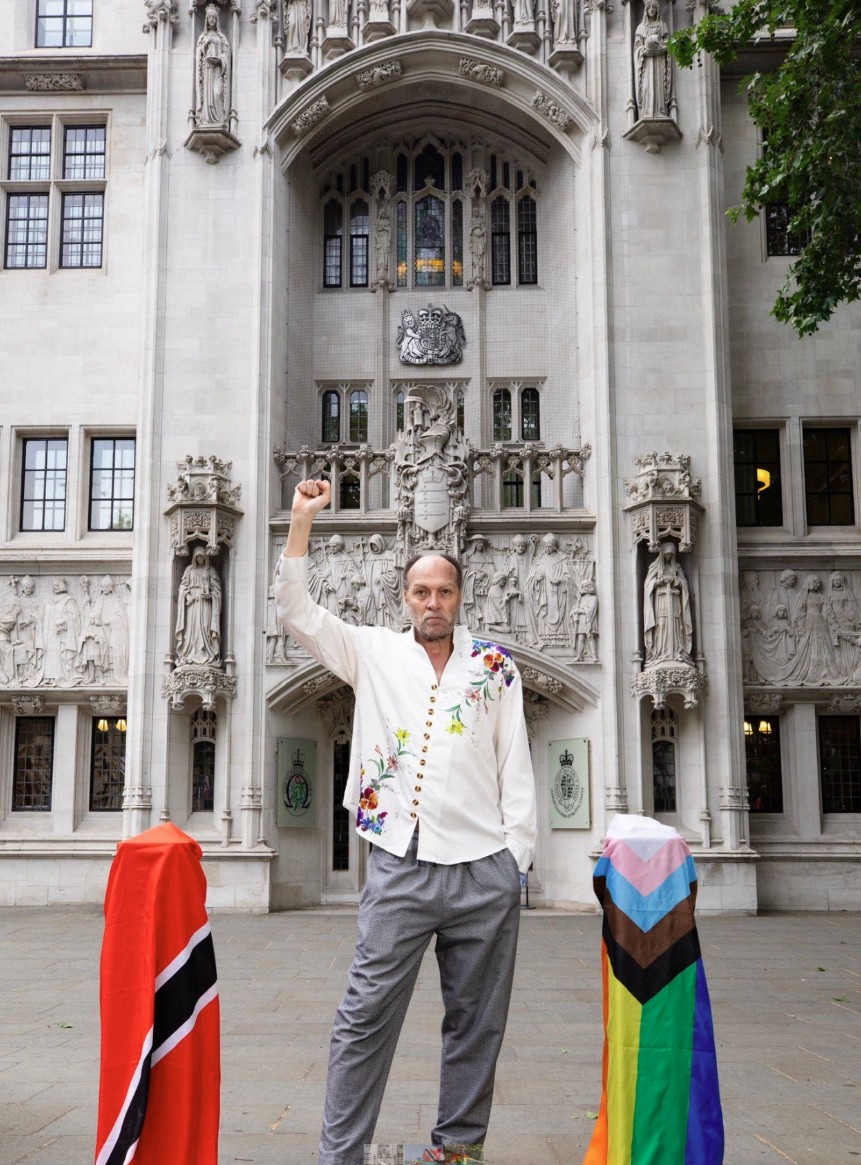
Jason Jones
The Judicial Committee of the Privy Council (JCPC) ruled on Tuesday that Trinidad and Tobago’s laws criminalising adult consensual same-sex intimacy are unconstitutional, delivering a landmark victory for human rights in its judgment in Jason Jones v. Attorney General of Trinidad and Tobago. The JCPC is based in London but is the final court of appeal from the courts of Trinidad and Tobago.
Prior to this historic decision, Trinidad and Tobago was one of some 34 Commonwealth countries continuing to criminalise homosexuality based on colonial-era British laws. Under these laws, consensual same-sex intimacy is punishable by imprisonment.
This major legal victory for international human rights adds to a series of recent challenges to the constitutionality of colonial-era anti-homosexuality laws across the Commonwealth: in recent years, decriminalisation has been achieved in India, Antigua and Barbuda, and St. Lucia, citing an original 2018 Trinidad and Tobago High Court judgment in favour of Jason Jones’ case.
The Board stated in its unanimous judgement: “The ability to form a deep connection with another person through an intimate and loving relationship is a vital interest for all human beings.” In rejecting the State’s argument, the Board also asserted that the Constitution must protect people in the circumstances in which they live today. The judgment recognises tolerance and broadmindedness as hallmarks of the democratic society established by the Constitution of Trinidad and Tobago.
The key findings of the Board in reaching its decision were:
The Sexual Offences Act 1986 (SOA 1986) is not saved law: the judgment makes clear that oppressive colonial era laws that breach fu
ndamental human rights will not be saved just because they are “traditional”. Savings law provisions must be construed narrowly and the SOA 1986 was not a repeal and reenactment within the meaning of the relevant constitutional provisions (a pre-requisite to fall within the scope of the Savings Clause).
Nor was it rescued by the special legislative procedure by which it was passed (under s.13 of the Constitution): that will not save provisions which breach a citizen’s fundamental human rights if the provisions are not reasonably justifiable in a society that has a proper respect for an individual’s rights and freedoms. All of the judges who considered the case in Trinidad & Tobago had agreed that the provisions were not reasonably justifiable and the Privy Council agreed.
The judgment follows a final appeal hearing in London on 8 July 2026 and brings to a close a legal battle that began in 2015. Notably, Jason Jones’ case challenged the application of the ‘avings Clause’, which protects certain laws predating the country’s independence from constitutional challenge. It was this clause that caused the case’s 2018 victory to be reversed, leading to this year’s final appeal.
With this win, the door is now open for more widespread challenge to anti-homosexuality laws across the Caribbean and the wider Commonwealth. At a time when LGBTQ+ rights are under renewed threat around the world, today’s final judgment gives accelerated momentum to international campaigning efforts to achieve and cement protections for the LGBTQ+ community worldwide.
Commenting on the judgment, Jason Jones, human rights campaigner and appellant in the appeal, said: “Whilst I welcome this judgment, it does not, however, address the main issues of human rights and equality for LGBTQ+ people which have been denied using British colonial era laws across the Commonwealth and beyond. These laws never reflected who we are as a people and a nation: diverse, multiracial, and secular. They told LGBTQ+ people that we were criminals in our own country. That message ends today.
“On a personal note, I am extremely proud to have led this challenge, but the work doesn’t end here. Let this victory be the rallying call to accelerate the fight for full equality and rights for all people, everywhere”.
Mr Anand Ramlogan SC, counsel for the Appellant, said the judgment is “A landmark victory for gay rights, equal dignity and respect for private and family life in Trinidad and Tobago. Gay rights form part of the wider struggle for human rights. Every person is entitled to the protection of the Constitution, regardless of their sexual orientation.
“Our national anthem promises that ‘every creed and race find an equal place’. The principle of belonging must embrace every member of our national community. Every person deserves to live with equal dignity and respect”.
Bell Ribeiro-Addy MP, who convened a parliamentary reception in support of the case this year, said: “Today’s ruling is not only a victory for Jason but for LGBTQ+ people across Trinidad and Tobago and in former British colonies, who have lived for far too long under the threat of these repressive laws. Jason has fought his case for nearly a decade, often at great personal cost, and I was proud to host him in Parliament and support him ahead of the hearing. Britain exported these homophobic laws across the Commonwealth, and we have a responsibility to stand with those still working to end the continued damage they do”.
Caroline Edwards of Travers Smith LLP, Jason’s solicitor in the appeal, commented as follows: “This is an emphatic and decisive judgment which upholds the judgment of the Court of First instance in Trinidad & Tobago and the dissenting judgment of the T&T Court of Appeal.
The judgment makes clear that Jason’s rights as a gay man to respect for his private and family life are at the core of his existence as a human being and that the ability to form a deep connection with another person through an intimate and loving relationship is of vital interest for all human beings.
“This judgment is huge. It is a victory for Jason, and for his courage and conviction and perseverance throughout. It is also a victory for all gay men and women in T&T, and far beyond, and for all who support the fundamental human rights of all individuals regardless of sexual orientation. Its impact will be felt for years to come.”

Share this article:

Subscribe to our newsletter to not miss articles like this one:
 SUBSCRIBE