Is this email not displaying correctly? View it in your browser.
31st July 2026
The only all-Ireland daily news service for lawyers
Jobs At A Glance

Get your legal job vacancies listed on Irish Legal News by contacting our advertising manager, Jeff Anderson, on jeff@irishlegal.com.

You can download the Irish Legal News media pack from our website.

Today’s Headlines
Jobs

Justice

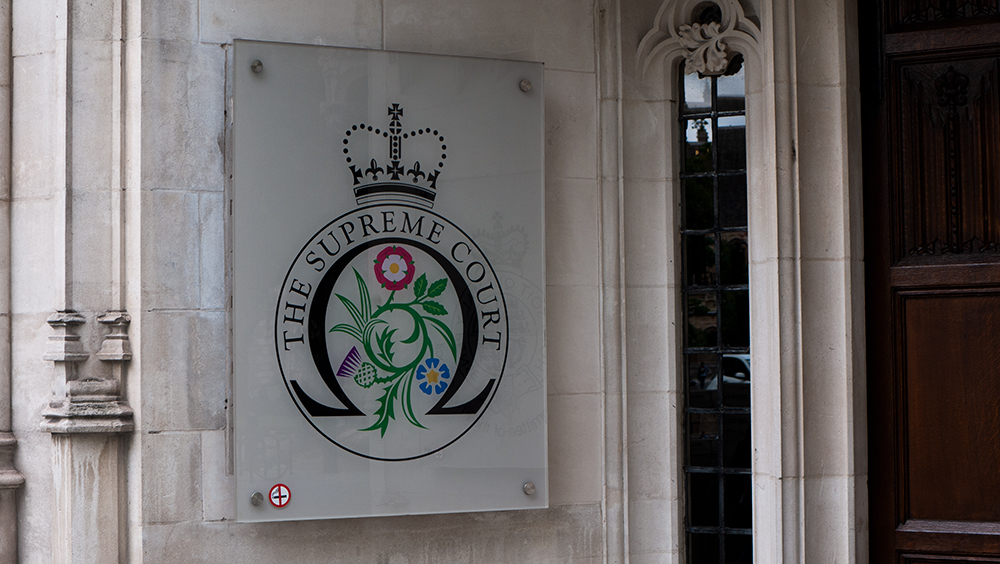
Location: London Supreme Court of the United Kingdom

As a result of the retirement of Lord Reed of Allermuir in January 2027, applications are sought for the appointment of a Justice of the UK Supreme Court.

The UK Supreme Court and Judicial Committee of the Privy Council hear a wide range of very complex and high-profile legal appeals, which can have a considerable impact across the United Kingdom and beyond.

All those appointed to the Court need to be people of truly exceptional intellectual and legal ability, with sound judgment and decisiveness.  The selection commission is looking for candidates who can show an ability to contribute to the collegiate decision-making of the Court, a sensitivity to the needs of different communities and groups and an ability and willingness to engage in the wider representational and leadership role of a Justice, together with an appreciation of the developing nature of the constitution and law in England, Scotland, Northern Ireland and Wales.

The Supreme Court is required by statute to have judges with a knowledge of, and experience of practice in, the law of each part of the United Kingdom. For this recruitment, the selection commission is looking for a candidate with knowledge of, and experience of practice in, the law of Scotland.

The UK Supreme Court’s commitment to diversity and inclusion is deeply rooted in its values. We recognise that diversity brings richness to the judiciary and we welcome applicants from all backgrounds. We support part-time and flexible working, subject to the needs of the Court.

Details about the selection process can be found on the UKSC website. Further information about the skills and experience required for the role can be found in the information pack here. Please contact Grainne Hawkins grainne.hawkins@supremecourt.uk tel: 020 7960 1906) for an application form.
 
The closing date for applications is 5pm 25th August 2026.

Latest News

NI Crown Court: Former primary school teacher receives prison sentence for domestic abuse

By Gillian O'Hanlon BL, case reporter

NI Crown Court: Former primary school teacher receives prison sentence for domestic abuse

Northern Ireland’s Crown Court has sentenced a former primary school teacher to three years’ imprisonment for campaign of domestic abuse.

Delivering judgment for the Crown Court, His Honour Judge Patrick Lynch opined: “The defendant’s conduct was over a period of eight years. This was a continuous campaign of deliberately humiliating treatment directed towards his spouse and mother of his children for no reason other than his own self-willed desire to dominate, his arrogance with a total disregard for her welfare and that of his children.”

Background

The complainant and the defendant were a married couple living with their two young children during the relevant eight-year period.

The complainant alleged that the defendant frequently sent abusive text messages to her, followed her into the bathroom to shout at her, blocked her car to prevent her leaving, tried to turn the children against her family and blamed her for things such as the defendant losing his driving licence.

Further specific and one-off incidents of abuse were also alleged by the complainant, including telling the children that she did not want the defendant to be a part of their family anymore and smashing objects around the house.

The defendant pleaded guilty to one count of domestic abuse between 21 February 2022 and 7 November 2024, aggravated by reason of involving a child and one of harassment.

The defendant was 44 years of age at the time of sentencing and described himself as having grown up in a religious household.

The pre-sentence report considered that while the defendant had acknowledged some wrongdoing and accepted some blame, he failed to acknowledge the distress caused to her or the impact of his behaviour on their children and was assessed as a medium likelihood of reoffending.

A psychiatric report recorded that the defendant had no previous psychiatric history until 2016, when he left work as a primary school teacher due to stress. The report described the defendant’s mental health deteriorating from November 2024 following his marital breakdown and criminal proceedings.

The psychiatrist informally assessed the defendant as having above average IQ and accepted the complainant’s description of calculated and instrumental aggression.

The Crown Court

Judge Lynch considered that the familial circumstances of the defendant’s parents, which had been set out in mitigation, were not such as to attract a substantially reduced sentence or to affect the character of such sentence.

The court outlined that the sentencing in section 1 of the Domestic Abuse and Civil Proceedings Act (NI) 2021 had not been considered in any detail in Northern Ireland apart from in R v WD [2025] NICA 1.

Noting that WD dealt with a very specific set of facts, Judge Lynch explained: “Whilst it was held that the two distinguishable events on the one day constituted a course of behaviour the statement by the Justice Minister Naomi Long in introducing the second stage of the bill in The Assembly made it clear that the legislation was directed at the sort of behaviour evidenced in this case”.

Recognising that WD did not either set out a sentencing regime nor indicate the criteria for assessing culpability and degrees of seriousness, the court proceeded to describe a framework for the assessment of aggravating and mitigating factors involving analysing the behaviour itself, the effect the behaviour had on the victim, whether the perpetrator intended to cause physical or psychological harm or was reckless, and circumstances particular to the offender.

Finding that there were no guideline cases in Northern Ireland nor in any equivalent jurisdictions in the United Kingdom in this context, Judge Lynch considered that the legislature had determined that the maximum sentence should be 14 years’ imprisonment, which would inform the court as to the appropriate parameters.

Having considered inter alia the evidence and the victim impact statement of the complainant, the Crown Court opined that the defendant had waged “a continuous campaign of deliberately humiliating treatment directed towards his spouse and mother of his children for no reason other than his own self-willed desire to dominate, his arrogance with a total disregard for her welfare and that of his children”.

The court was satisfied that the persistent nature of the defendant’s conduct indicated a “deliberate, not reckless intent to cause psychological harm” and “Given his intelligence there must have been a full awareness of the effect of his behaviour towards the victim.”

Deciding to take a totality view and finding that the defendant’s culpability was medium to high, as was the harm caused, the Crown Court took a starting point of 42 months’ imprisonment.

The court explained that count 1 was charged with the statutory aggravator pursuant to s.9 of the Act to reflect the presence of children during many of the incidents, adding 12 months to the sentence therefor.

Conclusion

Having permitted a one-third reduction in the sentence to allow full credit for the defendant’s guilty plea, the Crown Court imposed a sentence of three years’ imprisonment on count 1, half in custody and half on license, with 11 months’ imprisonment to run concurrently for count 3 and an offender levy of £50.

The King v Kevin Jones [2026] NICC 10

Lawyer found not guilty of murdering father by reason of insanity

Lawyer found not guilty of murdering father by reason of insanity

A lawyer who fatally stabbed his father during a psychotic episode has been found not guilty of murder by reason of insanity following a trial at the Central Criminal Court.

Daire McCormack George, 31, admitted killing his father, Scott George, but pleaded not guilty by reason of insanity. The jury returned the special verdict after hearing psychiatric evidence that he was suffering from schizo-affective disorder at the time of the attack.

The court heard Mr McCormack George stabbed his father 27 times at the family home in Drumans End, Tobersool, Balbriggan, Co Dublin, on December 12, 2024.

Evidence showed he had first been diagnosed with a mental health disorder in 2018 and had responded well to treatment. However, after a reduction in his anti-psychotic medication, he suffered a relapse and developed the delusional belief that his frail, housebound father intended to kill his mother and sister. He believed he had to kill his father to save them.

Psychiatrists told the court Mr McCormack George’s mental disorder meant he met the legal test for a verdict of not guilty by reason of insanity. Both the prosecution and defence urged the jury to return that verdict.

In his closing address, defence counsel Michael Bowman SC said the psychiatric evidence established that Mr McCormack George’s delusions had overwhelmed his judgment. Prosecuting counsel Vincent Heneghan SC described the case as “sad and tragic” and said all of the evidence supported the special verdict.

Ms Justice Eileen Creedon told jurors that a verdict of guilty of murder would be contrary to the unchallenged expert medical evidence. She thanked the jury for their attention to what she described as a “sad and difficult case” and excused them from jury service for five years.

Following the verdict, members of Mr McCormack George’s family embraced one another and shook hands with lawyers on both sides.

Mr McCormack George was remanded to the Central Mental Hospital until August 13, when the court will hear evidence on his ongoing psychiatric treatment.

Tipperary left with one legal aid solicitor after mass resignations

Tipperary left with one legal aid solicitor after mass resignations

Tipperary has been left with just a single solicitor willing to take legal aid cases after 33 lawyers resigned from the county’s criminal legal aid panel in an escalating dispute over fees.

The county, which has two court districts, previously had 34 solicitors providing legal aid services.

The mass resignations come amid a nationwide row between justice minister Jim O’Callaghan and criminal defence solicitors over proposed changes to the legal aid payment system.

Maura Derivan, a member of the Tipperary Solicitors’ Bar Association and a former president of the Law Society, said solicitors were seeking “a fair and proper model” for remuneration that reflected the length and complexity of criminal cases.

The minister has proposed replacing the current system of paying solicitors for each court appearance with a flat fee of €520 per case, regardless of the number of appearances required. He has said officials will review cases involving more than 20 court appearances.

Ms Derivan said the proposal would leave solicitors receiving “basically, €26 to go and spend your day in court, and all the preparation that goes with that” if a case was adjourned 20 times.

She said adjournments were often beyond solicitors’ control, adding: “Anything can happen in the meantime. A child might need a psychologist, someone might need an interpreter. The model that was there before catered for that.”

Mr O’Callaghan has also proposed ending separate payments for each charge faced by an accused. He cited one case involving 130 charges, where a law firm claimed €31,000 for a single day in court.

Lawyers argue that each charge requires separate preparation. Ms Derivan said: “It’s like calling out a plumber for a leaky tap, which is going to take half-an-hour, and then discovering they have to take up the floorboards because there is a burst pipe, and then asking them to fix the washing machine while they are there, while only paying them for the leaky tap.”

Hundreds of solicitors have withdrawn from legal aid panels across Ireland, leading to thousands of criminal cases being adjourned. Around 70 solicitors representing all but two criminal law firms in Dublin voted on Thursday to continue their withdrawal of services.

UK Supreme Court to hear challenge to Palestine Action terror ban

UK Supreme Court to hear challenge to Palestine Action terror ban

Palestine Action co-founder Huda Ammori has been granted permission to challenge the group’s proscription as a terrorist organisation before the UK Supreme Court.

Palestine Action was banned under terrorism legislation in July last year. Ms Ammori has challenged the decision, arguing that the ban is unlawful and disproportionate.

The English High Court ruled in her favour in February, but that decision was overturned by the Court of Appeal last month.

The UK Supreme Court has now granted permission to appeal and said the case will be heard in the final quarter of this year.

The court said it was arguable that the ban represented a disproportionate interference with Articles 10 and 11 of the European Convention on Human Rights, which protect freedom of expression and freedom of assembly.

The outcome could affect more than 3,500 people arrested for alleged support of Palestine Action, whose cases have been put on hold pending a final ruling on the legality of the group’s proscription.

Ms Ammori welcomed the decision, saying: “The proscription of Palestine Action has become a vehicle for a far broader crackdown on expressions of solidarity with the Palestinian people.

“This unprecedented attack on free speech and the right to protest in this country is already having a chilling effect at a time when speaking out about Israel’s crimes could not be more urgent.”

She has also pledged to take the case to the European Court of Human Rights if the ban is ultimately upheld domestically.

The Supreme Court’s announcement coincided with further arrests linked to demonstrations in support of Palestine Action outside Westminster Magistrates’ Court in London.

The Metropolitan Police said officers arrested 77 people, with most detained on suspicion of expressing support for a proscribed organisation. Four others were arrested on suspicion of encouraging or assisting a criminal offence.

Competition launched to appoint new justice of UK Supreme Court

Competition launched to appoint new justice of UK Supreme Court

Following the announcement by Lord Reed that he will retire from the Supreme Court in January 2027, applications are now sought for the appointment of a justice of the Supreme Court of the United Kingdom. 

The UK Supreme Court and Judicial Committee of the Privy Council (JCPC) hear a wide range of very complex and high-profile legal appeals, which can have a considerable impact across the United Kingdom and beyond. All those appointed to the court need to be people of truly exceptional intellectual and legal ability, with sound judgment and decisiveness.

The selection commission welcomes applications from the widest range of people eligible to apply. The Supreme Court is required by statute to have judges with a knowledge of, and experience of practice in, the law of each part of the United Kingdom. For this recruitment, the selection commission is looking for a candidate with knowledge of, and experience of practice in, the law of Scotland.

In this video, Lord Reed explains what the role of a justice entails.

In addition to the court’s legal work, justices also participate in a wide range of activities which promote understanding of the court, and help to engage the public in educational activities. This ranges from judging moots and answering questions from school pupils, to the delivery of public speeches and addresses on various topics of the Law. Recently, Lord Doherty delivered a lecture to the Royal Faculty of Procurators when the court sat in Glasgow.

Further information about the skills and experience required for the role, and how to apply, can be found in the information pack here. The closing date for applications is 25th August.

Mason Hayes & Curran joins Hidden Disabilities Sunflower programme

Mason Hayes & Curran joins Hidden Disabilities Sunflower programme

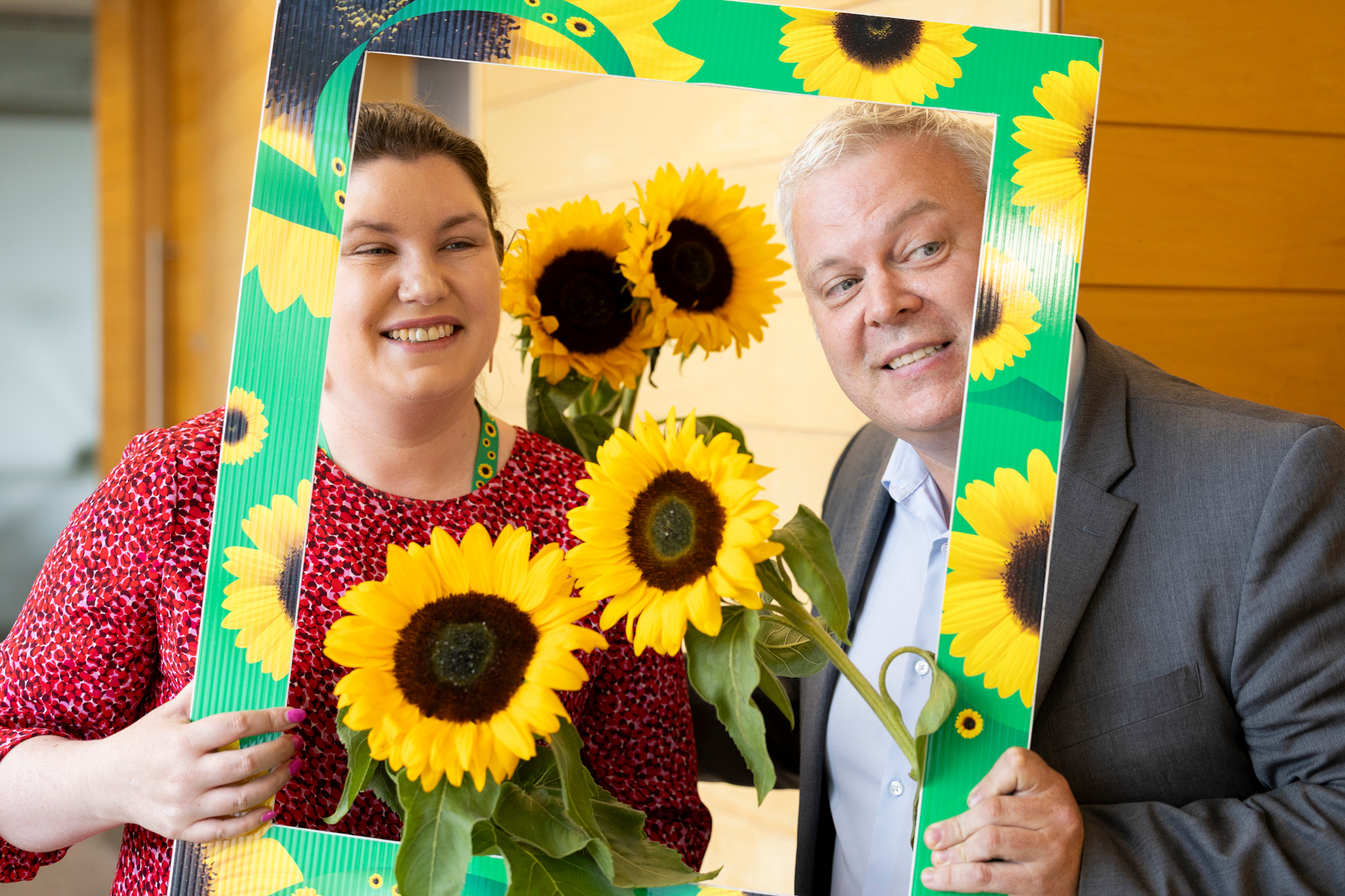
Mason Hayes & Curran is the first law firm in Ireland to join the Hidden Disabilities Sunflower programme to support clients and colleagues with non-visible disabilities.

The Sunflower is recognised internationally as a symbol of hidden disability. Typically worn voluntarily as a lanyard or badge, it lets someone indicate they may need a little extra time or support. Non-visible disabilities include autism, chronic pain, dementia, anxiety and sensory sensitivities, among others.

The firm launched the programme at its Dublin office with writer and broadcaster Stefanie Preissner, who spoke about receiving an autism diagnosis as an adult and the difference it makes when workplaces understand non-visible disability.

Preissner created the RTÉ drama Can’t Cope, Won’t Cope. She also wrote for and appeared in The Walsh Sisters, based on the novels by Marian Keyes.                                                                                         
Gerard Kelly SC, partner and chair of the Diversity Committee at Mason Hayes & Curran, said: “People should not have to explain their personal circumstances before they are met with understanding. The Sunflower gives someone a way to ask for a bit of understanding, without having to explain why.

“By joining the programme, we are helping our people recognise the symbol and respond appropriately. This forms part of our wider work to make the firm more inclusive and accessible for our colleagues and clients.”

As a Sunflower member, Mason Hayes & Curran is providing staff with awareness training and resources across the firm. Lanyards and badges are available for those who choose to use them, and a network of Sunflower Champions will support the programme internally.

Sinéad Lucey Brennan, director Ireland & Northern Ireland at Hidden Disabilities Sunflower, said: “We welcome Mason Hayes & Curran as the first Irish law firm to join the Hidden Disabilities Sunflower programme. Around one in five people in Ireland live with a disability, and 80 per cent of disabilities are non-visible. Recognising that in a professional setting makes a real difference. By training its people and introducing the Sunflower, Mason Hayes & Curran is making it easier for people to seek support without having to explain their personal circumstances.”

IHREC: Ireland at a human rights crossroads

IHREC: Ireland at a human rights crossroads

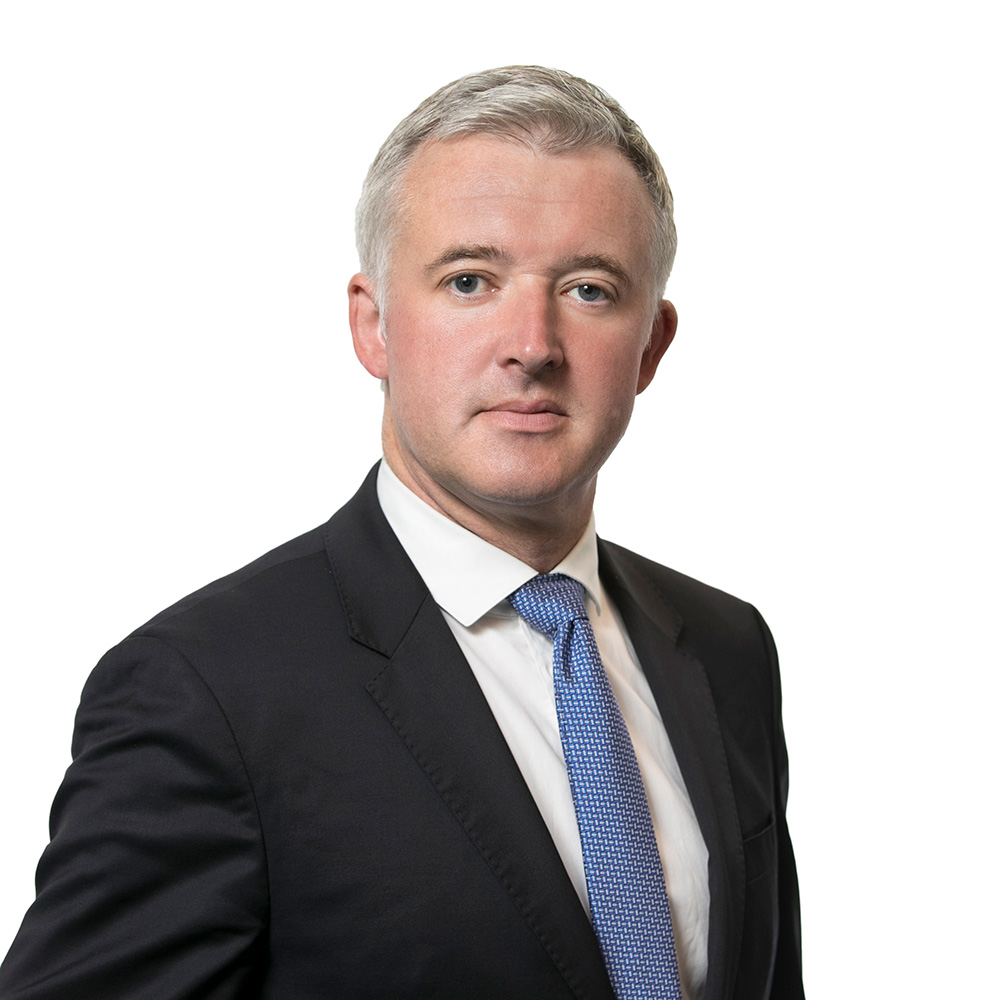
Liam Herrick

Ireland’s human rights and equality framework is facing significant challenges as global instability, rising inequality, pressure on democratic institutions and increasing hostility towards minority communities create new tests for rights protections, according to the Irish Human Rights and Equality Commission’s (IHREC) annual report.

The report warns that the international human rights system is experiencing one of its most challenging periods since its establishment following the Second World War, with armed conflict, authoritarianism, attacks on the rule of law and growing threats to civil society placing pressure on protections that many have long taken for granted.

The report finds that many of these global pressures are reflected in Ireland, with housing insecurity, economic inequality, discrimination and polarised public debate affecting people’s ability to participate fully and equally in society.

However, IHREC emphasises that this moment also presents an opportunity to renew commitment to human rights and equality as the foundations of a fair, inclusive and resilient society.

Launching the report, chief commissioner Liam Herrick, said: “Human rights and equality are not abstract principles. They are about whether people can live with dignity, access essential services, participate fully in society and feel that they belong.

“Ireland has a strong democratic tradition and an international reputation for supporting human rights, equality and the rule of law. But we cannot assume that progress is permanent. The protections built over generations require active commitment, investment and vigilance.

“The challenge now is to ensure that rights recognised in law are rights experienced in people’s everyday lives. Equality must be something people feel and experience, not simply something that exists on paper.

“At a time when democratic values are under pressure internationally, Ireland has an opportunity to demonstrate leadership by strengthening the institutions, protections and public confidence that underpin a rights-respecting society.”

Eighty-four postcards sent from Armagh in support of imprisoned Georgian journalist

Eighty-four postcards sent from Armagh in support of imprisoned Georgian journalist

Credit: Simon Robinson

Members of the audience at the John Hewitt International Summer School in Armagh wrote 84 postcards of support to imprisoned Georgian journalist Mzia Amaglobeli on Wednesday in a show of international solidarity.

The postcards were written during Irish PEN’s annual Freedom to Write event at The Marketplace Theatre, where an empty chair was left on stage to represent Ms Amaglobeli, who has been imprisoned in Georgia since January 2025.

Audience members were invited to write personal messages which will now be sent to Ms Amaglobeli in prison, demonstrating that her case is being watched far beyond Georgia’s borders.

Caoilfhionn Gallagher KC, international counsel for Ms Amaglobeli, said: “My brave client, Mzia Amaglobeli, has been unjustly imprisoned since January 2025. She has the dubious honour of being the first female journalist imprisoned in Georgia for politically motivated reasons since the country’s independence in 1991.

“It was extremely moving to see so many people thousands of miles away, in Armagh, take action to support her. It is long past time to Free Mzia.”

The audience heard Ms Gallagher highlight the growing threat to journalists around the world.

Lia Mills of Irish PEN/ PEN na hÉireann, said: “People everywhere are profoundly moved and inspired by the story of Mzia’s steadfast courage and resistance to state bullying.”

UAE launches world’s first fully integrated AI-powered judicial platform

UAE launches world's first fully integrated AI-powered judicial platform

The United Arab Emirates has launched what it says is the world’s first fully integrated AI-powered judicial platform, designed to improve the efficiency of court proceedings while leaving final decisions in the hands of judges.

Sheikh Mansour bin Zayed Al Nahyan, vice president, deputy prime minister and chairman of the Presidential Court, described the platform as “a new global achievement” that reinforces the UAE’s position as a leader in government and judicial innovation.

The system will use AI to analyse case files, search legislation and judicial precedents, generate legal recommendations and assist with drafting judicial documents. It is also intended to speed up litigation, reduce administrative costs and promote greater consistency in legal decision-making.

Officials stressed that the platform is designed to support, rather than replace, judges, with all rulings remaining subject to human oversight.

The initiative builds on the UAE’s wider programme of judicial digitalisation, which has included remote court hearings, digital litigation services and AI-assisted legal advice.

While a number of jurisdictions have introduced AI tools for legal research and court administration, the UAE says its platform is the first to integrate multiple AI functions into a single judicial system.

Legal experts have welcomed the potential efficiency gains but cautioned that the platform’s success will depend on safeguards around data protection, transparency, algorithmic bias and judicial independence. They emphasised that AI must remain a decision-support tool rather than a substitute for judicial authority.

Review: How Germany tamed the Baader-Meinhof gang

By Robert Shiels

Review: How Germany tamed the Baader-Meinhof gang

Please note a preliminary point: the title of this book refers to ‘RAF Terror’. The list of abbreviations in the book does not assist the reader with the relevant meaning of ‘RAF’. There is only a brief mention of the full name of the organisation well into the book.  

The particular RAF here was the once well-known Red Army Faction, a West German far-left militant group active from 1970 to 1998: it was known for bombings, assassinations, and kidnappings aimed at challenging what it saw as a fascist state.

The politics of the RAF were those of destroying a capitalist and inhumane system, necessarily they thought, by means of violence against the state and the individual. There were only a few main or core RAF participants but they were assisted by a sizeable number of sympathisers.  

The RAF, also referred to in the media as the Baader–Meinhof Group, was founded in 1970 by Andreas Baader, Ulrike Meinhof, Gudrun Ensslin, and Horst Mahler, emerging from the radical student protest movements of the late 1960s in West Germany.

Political and security matters have moved on since the RAF was active, at least a generation ago. In a crowded field, there have been many other terror organisations. The RAF, however, seem to have set the European standards of executive dilemma.  

They carried out a sustained campaign of terrorism, included bombings, assassinations, kidnappings, and bank robberies. The peak of activity was known as the German Autumn of 1977. In that year, the German industrial leader was kidnapped and later a plane was hijacked.

On 13 October 1977, the Lufthansa twin-engine, short-haul, aircraft, named ‘Landshut’, to fly from Palma de Mallorca to Frankfurt am Main in 135 minutes. The 86 passengers and five crew (less some too injured to fly immediately) reached their destination 105 hours later after a diversion to several countries.  

Hanns-Martin Schleyer, the industrialist, was murdered by his abductors, as was Jürgen Schumann, the Lufthansa captain. The ‘Landshut’ hostages were freed dramatically by state intervention. All these events gave the Federal Republic of Germany in world view a serious test of crisis management.

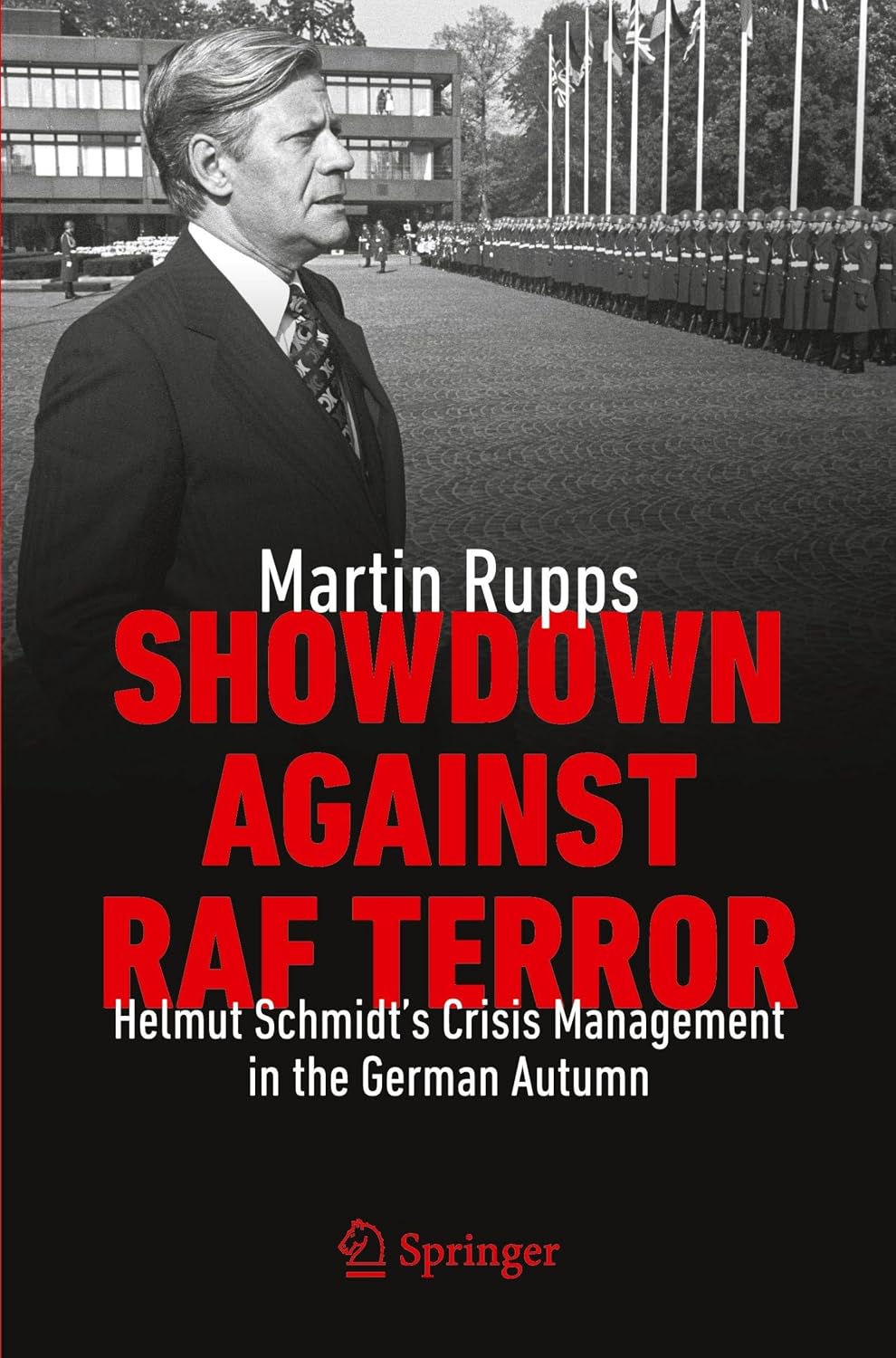
Martin Rupps is a political scientist and historian, and in his book, he offers insights into the thoughts and actions of Chancellor Helmut Schmidt and the members of the core and extended crisis teams of the West German government.  

The narrative is seriously interesting for those who might recall the story, and others who do not. It was reported at the time as a wholly new development in criminality with added political motivations. The resolution of the immediate issues was not awash with precedents.

The German government had two problems: first, the RAF had abducted and threatening the life of a serious trade representative in society. Secondly, some Palestinians who were sympathetic to the RAF hijacked a plane and threatened the crew and passengers.

Rupps is good on the details of the hijacked plane passing through various airspaces while, and its scarcely believable now, trying to find an airport to land. The lax preparation of the whole hijacking venture is exposed in these events.    

Any political inconsistencies between the groups were irrelevant: the consistencies were that they threatened the credibility of the state to deal with them. That was the deeply political point facing Helmut Schmidt.      

The concluding view of this book is, as understood by your reviewer, that the collegiate view of the inner and larger advisory groups of German government was resolved not to accede to any political demand made under threat, even although lives were at risk.

Collegiate views are a safety net but ultimately the decision on the balance of relevant issues lay with Helmut Schmidt as Federal Chancellor. In later life he talked of the moral dilemmas of the time. However, it seems then that he was resolute: the Prussian idea of reasons of state prevailed, even at the risk to individuals.    

The lessons of the story include the tone of the rhetoric of the political leadership when announcing matters to the public; the free discussion necessary at executive level when dealing with the crisis; the necessity of a collegiate style of decision-making; and the sensitivity necessary with the nearest relatives of any hostages.  

These may be early issues for security people, as suggested earlier, and overtaken by events since but the book is still important in laying out the nature and extent of decision-making that may at a moments notice be put before our elected representatives.    

The main problem for the general reader of English text is that the book needs a more rigorous translation. As the admirable Helmut Schmidt might have said of the text: “Es ist gut, aber nicht gut genug”.

Dear reader, that means via Google translation services, possibly used extensively by Rupp; “It’s good but it’s not good enough.” Rupp with a good narrative, sadly, has sold himself short: “Er hat sich selbst unterschätzt”.

Showdown Against the RAF Terrorists: Helmut Schmidt’s Crisis Management in the German Autumn by Martin Rupps. Published by Springer, 288pp, £20.99.

Rights watch

Rights watch

Our weekly round-up of human rights stories from around the world.

UN rights chief Turk wins second term despite US and Israeli opposition

Austrian lawyer Volker Turk set to become first UN rights chief to complete two four-year terms since post was created.

‘Her screams echo in my ears’: the trauma of so-called ‘honour killings’ in Pakistan

There were 470 women killed in such circumstances across the country last year, with rights groups saying the true toll will be even higher, reflecting a system that still protects the accused.

Spain deploys military to Ceuta after thousands of people breach Morocco’s border and at least 9 die

The head of the Ceuta regional government called for Madrid to declare a national emergency, warning that migrant reception centers were overwhelmed.

‘End this nightmare’: Wife of ailing Briton jailed in Saudi Arabia appeals for release

Amaher Nour breaks down in tears thinking of the husband she hasn’t seen for almost two years, and the impact his absence has had on her four children.

UN fact-finding mission urges Venezuela to reverse ICC withdrawal

The United Nations Independent International Fact-Finding Mission on Venezuela called on the Venezuelan government Monday to reverse its decision to withdraw from the Rome Statute, the treaty that established the International Criminal Court (ICC), warning that leaving the ICC would weaken accountability for serious human rights violations and limit victims’ access to justice.

Mutual respect ‘key’ to violence prevention

One polite request to lower the volume on a Bangkok BTS train has become one of Thailand’s most discussed incidents in the past week. Much of the debate has centred on nationality, tourism and whether the foreign visitors involved should have behaved differently.

Philanthropist behind Canadian human rights museum says family pausing funding over Palestinian exhibit

A Winnipeg philanthropist who played a critical role in bringing the Canadian Museum for Human Rights to the city says her family is pausing any financial support for the institution over concerns around an exhibit on the displacement of Palestinians.

And finally… wailing wall

And finally... wailing wall

Japanese police have arrested a 61-year-old musician accused of keeping his elderly neighbours awake for more than seven years by playing loud guitar music day and night.

Kyoto resident Kazunori Yokoi allegedly blasted dozens of guitars and his radio at high volume from 2019 onwards – despite repeated official warnings – according to police.

Four neighbours, aged between their 60s and 80s, complained of health problems including insomnia, depression and tinnitus. Police said the complaints eventually provided grounds to arrest Yokoi on assault charges.

Officers seized more than 40 guitars, many of them electric, along with amplifiers, CD players and radio cassette players from his home. Investigators recorded noise levels exceeding 80 decibels in the neighbourhood, comparable to the sound inside a moving train, according to city guidance.

“It was awful because all kinds of sounds were jumbled together all day,” one neighbour in his 60s told Kyodo News.

In Case You Missed It...

Please note that Irish Legal News accepts no responsibility for viruses. It's your responsibility to scan attachments.

Irish Legal News strives to be accurate. If you see anything in our publication which is misleading or wrong, please contact us.

You can find the most up-to-date information about how to contact Irish Legal News on our website.

© Irish Legal News Ltd 2026
You are receiving this email because you are subscribed to Irish Legal News.