Is this email not displaying correctly? View it in your browser.
25th June 2025
The only all-Ireland daily news service for lawyers
Today’s Headlines
Latest News

Court of Appeal: Former solicitor Michael Lynn re-sentenced by Court of Appeal

By Gillian O'Hanlon BL, case reporter

Court of Appeal: Former solicitor Michael Lynn re-sentenced by Court of Appeal

The Court of Appeal last month re-sentenced former solicitor Michael Lynn in respect of theft offences totalling over €18 million on the basis that the sentencing judge incorrectly handled the issue of credit for time spent on remand in Ireland.

Delivering judgment for the Court of Appeal, Mr Justice John Edwards explained: “While sentence selection is exclusively a judicial function, sentence implementation is an executive function. Time and again, the Irish appellate courts have emphasised that courts impose sentences without regard to future remission stressing that remission is solely and exclusively a matter for the executive branch of government.”

Background

The appellant, a former solicitor, was convicted on 10 counts of theft contrary to s.4 of the Criminal Justice (Theft and Fraud Offences) Act 2001 and on 19 February 2024 was sentenced by the Circuit Criminal Court to five-and-a-half years in prison on each count, to run concurrently.

The thefts in question, largely facilitated by the system of solicitors’ undertakings, amounted to €18,144,345 over a period of six months and involved six victims, all being financial institutions.

Following the collapse of his legal practice, a Law Society investigation commenced. The appellant had been due to appear before the High Court on 12 December 2007 in the “Solicitors’ Matters” list, but failed to appear. The High Court made an order for attachment against the appellant, but he had already left the jurisdiction.

The appellant moved from Portugal to Brazil in 2011. Thereafter, in 2013, the DPP decided to charge the appellant with theft offences and in circumstances where there was no prior extradition agreement with Brazil, Ireland entered into an ad hoc extradition agreement on foot of which the appellant’s extradition was secured.

The appellant was arrested in northern Brazil on 29 August 2013. He unsuccessfully contested his extradition to Supreme Court level in Brazil and was eventually extradited to Ireland on 1 March 2018, having spent approximately 4.5 years in inhumane prison conditions in Brazil which he described as posing “an ever present, latent threat of ultra violence”.

The appellant, having been deported, spent a further 105 days on remand in an Irish prison before obtaining bail pending his trial.

The appellant advanced 15 grounds of appeal against the severity of his sentence and against his conviction, with the Court of Appeal agreeing to hear the element of his appeal concerning the severity of his sentence first.

The appellant’s contentions included that the sentencing judge erred in the manner in which he structured the appellant’s sentence, alleging inter alia that when reducing the headline sentence of 16 years to 13 years by reason of the mitigation presented by the appellant, by including in that reduction a period of 105 days of pre-trial detention in Ireland, he was excluded from relying on that time served in custody for the purposes of an application for remission of his sentence.

Court of Appeal

On the issue of credit for the time spend by the appellant on remand in this jurisdiction, Mr Justice Edwards explained that there is no difficulty with due allowance being made at sentencing for time served on remand, “providing it is done in the right way, and in a way that shows judicial respect of the separation of powers”.

In this regard, the judge considered that if all that is being sought is no more a pro-rata deduction from or allowance against the proposed sentence in respect of time actually served in custody while on remand, a sentencing judge is at full liberty to make that deduction or afford that allowance and that this is frequently done by backdating the commencement date of the sentence or by nominating an appropriate sentence before deducting an appropriate portion of it to reflect credit.

The Court of Appeal identified a potential difficulty if the request must be construed as extending not just to the defendant receiving a pro-rata deduction or allowance, but rather that whatever allowance is made should be based on time “deemed” to have been served, rather than actual time served, to take account of a prisoner’s presumptive entitlement to standard remission in accordance with the statutory scheme set out in the Prison Rules 2007.

Mr Justice Edwards explained that the logic behind this, in part, is that if a person who spent no time on remand presumptively has the possibility of availing of standard remission in respect of their time in prison as a sentenced person, then a sentenced person who did spend time on remand should be in no worse position and should also be able to avail of standard remission in respect of all periods, including pre-trial and pre-sentence periods, during which they were deprived of their liberty in connection with the offences for which they were sentenced.

The court also observed that where there has not been a waiver, either expressly or by inference, of a claim for further credit based on additional time “deemed” to have been served, a sentencing judge cannot make any specific allowance designed to take account of both time served and additional time deemed to have been served so as to take account of a defendant’s presumptive entitlement to standard remission.

Mr Justice Edwards explained that this is because the implementation of a sentence is a function of the executive branch of government and remission is, therefore, not something that a sentencing court can take account of in light of the separation of powers and in light of the fact that there is no right to remission, rather it is a presumptive entitlement which can be earned or lost due to bad conduct.

The judge confirmed that the proper way to proceed, where a person seeks to have allowance made for time deemed to be served over and above time actually served, is to determine and impose the appropriate sentence without reference to time spent on remand, and to give an ancillary direction (to be included in the committal warrant) that the person should receive credit from the relevant executive authorities on account of time spent in custody on remand relating to the matter in question when that person’s release date is being determined.

The Court of Appeal considered that in circumstances where, immediately post-imposition of sentence and prior to the court rising, the appellant’s counsel had clarified that the appellant hoped to avail of standard remission earned in respect of all time spent on remand, including the 105 days spent in prison in Ireland, the sentencing judge was not entitled to infer a waiver on the appellant’s part of the opportunity to made a case to the executive to be afforded credit by way of standard remission for time spent on remand in Ireland.

In those circumstances, the court determined that the sentencing judge erred in failing to change the part of his order giving credit for time served on remand in this jurisdiction by a combination of straight deduction and backdating measures, and ought to have imposed a sentence containing no adjustment accounting for the 105 days, with a direction that in the executive’s calculation of the time to be served, the appellant should receive all due credit for time served on remand in this jurisdiction against the sentence being imposed.

Conclusion

Having found no other error in the sentencing judge’s approach, the Court of Appeal allowed the appeal in relation to the manner in which credit for time served on remand in Ireland was treated and quashed the sentence imposed by the Circuit Criminal Court.

On re-sentencing, the Court of Appeal removed the discount from the appellant’s sentence allowed in respect of the 105 days spent on remand in Ireland, with the result that the total discount to be applied to the headline sentence of 16 years was 10 years and three months, leaving a net post-mitigation sentence of five years and nine months in respect of all 10 counts, to run concurrently.

The Court of Appeal further directed that each sentence would date from 20 December 2023, and made a direction that in the executive’s calculation of the time to be served by the appellant, he should receive all credit lawfully due to him for the time served by him on remand in this jurisdiction exclusively in respect of those offences for which he was being re-sentenced.

The People v Michael Lynn [2025] IECA 131

A&L Goodbody opens redeveloped Dublin HQ

A&L Goodbody opens redeveloped Dublin HQ

Pictured (left–right): A&L Goodbody managing partner David Widger and Micheál Martin.

Taoiseach Micheál Martin last night joined A&L Goodbody for the official opening of its newly redeveloped headquarters at 25 North Wall Quay, Dublin 1.

Mr Martin addressed nearly 600 staff from ALG’s Dublin office to celebrate the next chapter for the firm in the heart of Dublin’s International Financial Services Centre (IFSC).

Following the conclusion of the redevelopment project, which began in 2022, the office now includes two additional floors, landscaped terraces, a new atrium and a purpose-built client suite, designed to enhance the client experience and foster deeper collaboration.

The “smart, technology enabled building” was redeveloped in partnership with property owner IPUT Real Estate with an emphasis on renewable energy and low carbon materials.

Despite being larger, the new 155,000ft² office is expected to use 67 per cent less energy than it did before, thanks to an all-electric heat pump strategy, high-performance façade and new smart technology.

The building has retained the majority (75 per cent) of its original structure, resulting in substantial savings (56 per cent) in carbon footprint and waste and reducing the embodied carbon intensity of the building.

Mr Martin said: “The opening of A&L Goodbody’s new office headquarters is a really exciting development — exciting for ALG, for Dublin’s business district and the wider Irish economy.

“As a leading Irish law firm, ALG has made a significant contribution to supporting growth in our economy and international investment. This landmark building provides a best-in-class sustainable HQ for a new era.”

David Widger, the firm’s managing partner, added: “This new headquarters reflects our confidence in, and ambition for, our business and for our clients. It is our building for the future, while staying rooted in the place we called home for over two decades.

“Since first moving to North Wall Quay in 1999, our firm has expanded significantly. The new building supports a state of the art, modern, working environment for those who work at ALG and the clients we support.

“Working with IPUT, we’ve created a building that meets the highest standards and reflects the values of our clients and our business — forward-looking, responsible and globally connected.”

LSRA chief to depart to join police ombudsman’s office

LSRA chief to depart to join police ombudsman's office

Dr Brian Doherty

The chief executive officer of the Legal Services Regulatory Authority (LSRA) is set to leave to take up a new role with Fiosrú.

Dr Brian Doherty has been nominated for appointment as deputy police ombudsman in Fiosrú, which was formally established in April as part of Garda oversight reforms.

A former barrister, Dr Doherty was called to the Bar in Northern Ireland in 1996 and initially practised in Belfast.

He held roles with the Office of the Police Ombudsman for Northern Ireland (PONI) and the Garda Síochána Ombudsman Commission (GSOC) prior to his appointment at the LSRA.

Tom Boland, chair of the LSRA, said: “On behalf of the authority, I would like to thank Dr Doherty for the dedication, commitment and vision he has shown for the past eight years as CEO of the Legal Services Regulatory Authority.

“Brian was appointed as the LSRA’s first Chief Executive in September of 2017 and has overseen the establishment of the LSRA including significant expansion of the organisation’s regulatory work and staff numbers.

“Under his capable stewardship, the LSRA has successfully established a robust and independent complaints handling function, including the establishment of the independent Legal Practitioners Disciplinary Tribunal.

“Brian has driven the organisation’s ambitious reform agenda in the arena of legal practitioner education and training, working closely with stakeholders to improve access to and diversity within the legal professions.

“Brian has also led on the introduction of several innovations in the legal services market including legal partnerships as a new business model for legal services delivery.

“Brian has achieved so much in his eight years at the LSRA and will be sorely missed by staff, stakeholders and Authority members. I wish him well in his new role as the deputy police ombudsman with Fiosrú, the Police Ombudsman.”

The police ombudsman, Emily Logan, said: “I congratulate Brian on his nomination to the role of deputy police ombudsman.

“Brian brings a wealth of experience to Fiosrú, in particular his years of experience in policing oversight and latterly as CEO of the LSRA, from which the organisation will greatly benefit.

“[CEO] Sheila McClelland, our senior leadership team and myself offer Brian many congratulations on his nomination and look forward to working welcoming him to Fiosrú.”

  • This article originally stated incorrectly that Dr Doherty had already left the LSRA. He will in fact leave in the coming months.

Ministers set out detail of ban on importing goods from Israeli settlements

Ministers set out detail of ban on importing goods from Israeli settlements

Simon Harris

Ministers have set out their proposals to ban the importation of goods from illegal Israeli settlements in the West Bank and East Jerusalem.

The general scheme of the Israeli Settlements in the Occupied Palestinian Territory (Prohibition of Importation of Goods) Bill has now been published.

It follows a years-long debate over the Occupied Territories Bill, tabled in 2018 by Independent Senator Frances Black, which proposes to ban the importing of goods and services from Israeli settlements.

The government has argued that restrictions on trade with Israel only became compatible with EU law after the landmark advisory opinion handed down by the International Court of Justice (ICJ) in July 2024.

The new bill provides that the importation of goods from Israeli settlements in the occupied Palestinian territory (OPT), including East Jerusalem, will become an offence under the Customs Act 2015.

The prohibition created by the bill will also then engage the customs powers under the 2015 Act, including those relating to search, seizure and forfeiture.

The general scheme will now be referred to the Oireachtas Committee on Foreign Affairs and Trade for Pre-Legislative Scrutiny.

Tánaiste and foreign affairs and trade minister Simon Harris said: “The situation in Palestine remains a matter of deep public concern.

“I have made it consistently clear that this government will use all levers at its disposal to address the horrifying situation on the ground and to contribute to long-term efforts to achieve a sustainable peace on the basis of the two-state solution.

“Israeli settlements in the occupied Palestinian territory are illegal and threaten the viability of the two-state solution. This is the longstanding position of the European Union and our international partners. Furthermore, this is the clear position under international law.

“I have been absolutely clear that we have yet to see an adequate response at EU level to the July 2024 Advisory Opinion of the International Court of Justice, notably as regards trade with Israeli settlements.

“This is an issue that I will continue to press at EU level and I reiterated my call for concrete proposals from the European Commission at the Foreign Affairs Council this week.

“However, pending an appropriate response at EU level, the government committed to advancing our own legislation on the matter and we have made a significant step forward now.

“I am acutely aware that this legislation has been a particular focus of public interest and attention here at home and I look forward to hearing the views of Oireachtas colleagues and key stakeholders on the general scheme.”

Family courts ‘need more resources’ as domestic violence reports hit record high

Family courts 'need more resources' as domestic violence reports hit record high

Keith Walsh SC

More resources are urgently needed in the family law system, a leading solicitor has said after new figures from Women’s Aid revealed reports of domestic violence are at a record high.

Women’s Aid said its national and regional frontline services were contacted 32,144 times in 2024, an increase of 12 per cent on the previous year and the highest contact rates in the organisation’s 50-year history.

Its frontline teams heard a total of 46,765 disclosures of incidents of domestic violence and abuse in 2024, including 41,432 against women and 5,333 against children — an overall increase of 17 per cent from 2023.

Keith Walsh SC, partner at Dublin firm Keith Walsh Solicitors, told Irish Legal News: “The 17 per cent increase in domestic violence disclosures to Women’s Aid unfortunately reflect the ongoing increases in court applications under the Domestic Violence Act 2018.

“There were 14,374 court applications in 2015 and the latest figures available for 2023 show there were 25,563 court applications that year, an increase of 8.6 per cent on the previous year and a 56 per cent increase over 10 years, which is shocking.

“Domestic violence applications make up over 60 per cent of all private family law cases in the District Court.”

He added: “Currently applications for domestic violence cases are being made in unsuitable court buildings around Dublin as we await the start of the construction of the new family justice courts in Hammond Lane.

“The increase in domestic violence and other family law cases is causing further pressure on the entire system and more resources are required to deal humanely with families and children who are forced to use this system.”

Mr Walsh also suggested the Domestic Violence Act 2018 should be reviewed “to see what changes could be introduced such as defining domestic violence behaviours and making them subject to the criminal law rather than the civil law”.

“It is clear now, as it has been for some time that the home is not a safe place and the state needs to intervene further and more effectively to protect its citizens,” he said.

Sarah Benson, chief executive officer of Women’s Aid, said today: “The number and nature of the disclosures of abuse to our frontline services is utterly appalling. However, this is just the tip of the iceberg.

“Thirty-five per cent of women in Ireland — one in three — suffer physical, psychological or sexual abuse from an intimate partner. Additionally, there are so many children, families and whole communities also impacted.

“Fear, stigma, and the debilitating impact of the abuse itself — but also persisting social attitudes to domestic violence — prevent victims from coming forward.

“So many victim-survivors lack the information or confidence to contact specialist services, and about one third will suffer in total isolation, telling nobody what is happening to them.

“We still have so much work to do to break this silence to encourage those in need to get the support they deserve.

“What we hear in our national and regional services is replicated across Ireland in local domestic abuse refuges and organisations.”

Davidson McDonnell celebrates 10th anniversary

Davidson McDonnell celebrates 10th anniversary

Pictured (left–right): Davidson McDonnell directors David McDonnell, Vicky Dummigan, Ross Davidson, Barbara Creed and Raymond Duddy.

Belfast firm Davidson McDonnell has celebrated 10 years since its establishment.

Established by Ross Davidson and David McDonnell in 2015, the firm now provides corporate/M&A, property, commercial litigation and banking advice to many of Northern Ireland’s largest business names.

The 35-strong team also includes a dedicated private client group advising on matrimonial and family, estate planning and probate matters.

With many of its staff qualified to practise in England and Wales as well as in Northern Ireland, the firm opened a new office in the City of London last year.

The firm has enjoyed strong success, with turnover increasing by over 15 per cent in the most recent financial year.

Mr Davidson said: “The development of Davidson McDonnell over just 10 years is testament to the strength, skills and advice of our talented teams, allied to our commitment to deliver a premium client service.

“In a competitive marketplace, we can be rightly proud of the impact we have made in Northern Ireland and across the UK and Ireland. We’re continually grateful for the trust which our clients place in us to deliver.

“Looking forward, we plan to grow our team further and to continue investing in existing and future talent to support our success.”

Director Vicky Dummigan added: “We’re delighted to mark 10 years with confident growth plans and a commitment to continue delivering high-quality, pragmatic, solution focused legal advice across our practice areas.

“We are grateful for the many client partnerships that have underpinned our success, and excited to further contribute to Northern Ireland’s vibrant business community.”

Comyn Kelleher Tobin welcomes record six trainees

Comyn Kelleher Tobin welcomes record six trainees

Comyn Kelleher Tobin has welcomed six new trainee solicitors in its largest ever intake.

The new trainees are Jordan Muir, Chloe Burdock, Jayne Doyle, Sarah O’Donovan, Áine Butler-ffrench and Ross Cudmore.

Managing partner Patrice O’Keeffe said: “Welcoming our largest ever intake of trainees marks a significant milestone for Comyn Kelleher Tobin.

“It reflects our sustained growth and our commitment to nurturing the next generation of legal professionals.

“We are excited to support these talented individuals, as they grow, thrive, and help shape the future of CKT.”

Non-jury court plan ‘may require referendum’

Non-jury court plan 'may require referendum'

Plans to establish a permanent non-jury court may require approval through a constitutional referendum, the government has been warned.

The Irish Council for Civil Liberties (ICCL) has called on the justice minister, Jim O’Callaghan, to clarify whether he plans to hold a referendum after he last month announced his intention to replace the Special Criminal Court.

A review group chaired by retired Court of Appeal judge Mr Justice Michael Peart led to the publication of two rival reports in 2023 after members failed to reach a consensus on the future of the Offences Against the State Acts 1939-1985.

While all members of the group agreed that the Acts should be repealed, four members backed the establishment of a new non-jury court while two suggested non-jury trials could take place where necessary without the need for a standing court.

The government said last month that it had accepted the recommendations of the majority report.

However, ICCL has called for a more “comprehensive response” from the government to both reports.

Executive director Joe O’Brien said: “ICCL’s longstanding position is that the Special Criminal Court should be abolished in the absence of a state of emergency because of its incompatibility with Ireland’s international and constitutional human rights obligations and the serious risks it poses to people’s right to a fair trial and to equality before the law.

“Whether it is possible or appropriate to create a permanent non-jury court without amending the Constitution is a live question and in fact the review group minority report described doing so as ‘constitutionally inappropriate’.

“We are keen to hear from the minister whether he has sought legal advice on this question and, if he has, what that advice says.”

He added: “This is far from the only outstanding question about the government’s plans for the Special Criminal Court.

“When she published the review group reports, the previous minister for justice announced that she would embark on a further consultation with key stakeholders.

“What was the outcome of that further review and does the minister propose to publish any further report arising from this consultation?”

The Department of Justice has been contacted for comment.

Final phase of Zero Tolerance strategy to be implemented over next year

Final phase of Zero Tolerance strategy to be implemented over next year

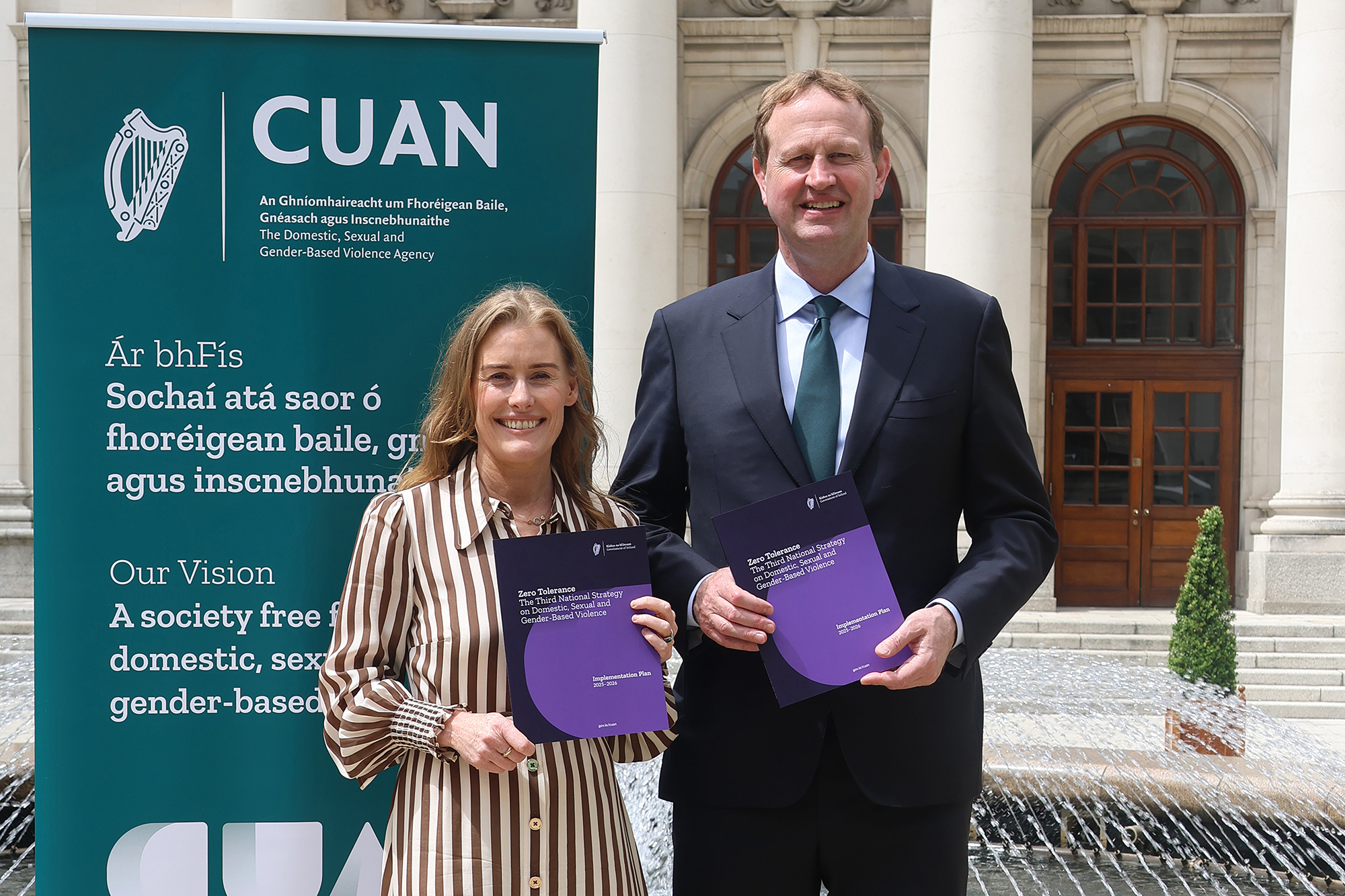
Pictured (left–right): CUAN CEO Dr Stephanie O'Keeffe and justice, migration and home affairs minister Jim O'Callaghan.

Plans to implement the final phase of the government’s “Zero Tolerance” strategy to tackle domestic, sexual and gender-based violence (DSGBV) have been set out.

The targeted implementation plan published today contains 95 actions across the strategy’s four pillars of “protection, prevention, prosecution and policy co-ordination”, with a strong focus on delivery and collective action to 2026.

Cuan, the DSGBV agency, worked in collaboration with officials from the Department of Justice and in consultation with other government departments, state agencies and external stakeholders to develop the plan for 2025-26.

Justice, migration and home affairs minister Jim O’Callaghan said: “This final implementation plan for the third national strategy draws directly from insights gained through ongoing monitoring and progress reporting by Cuan.

“It provides a focused roadmap to deliver on the whole-of-government commitment to a zero-tolerance approach to DSGBV.

“This is a plan focused on delivery, accountability and ensuring that we continue the momentum and focus on this issue.

“I am committed to building on what has already been achieved, and to strengthening implementation and identifying the actions we need to take now and where we need to go next to prepare a clear pathway toward the fourth national strategy.”

Priority areas include continuing national leadership and cross government alignment, expanding refuge accommodation, delivering a comprehensive national emergency domestic violence accommodation plan, and advancing legislative reform.

Legislative reform includes removing the guardianship rights of a person who has been convicted of killing their intimate partner; developing a mechanism to ensure any person in an intimate relationship can be informed if their partner has a history of domestic violence; and advancing provisions to ensure counselling records are only released where the Court decides that they contain material relevant to legal proceedings.

The plan also includes actions to continue to deliver impactful awareness campaigns on sexual consent and pathways to safety, and a comprehensive set of training actions to upskill frontline professionals across the health and social care sector, DSGBV services, the judiciary, courts and other justice agencies.

Mr O’Callaghan added: “The government is delivering on the commitments in the ‘Zero Tolerance’ strategy to achieve a society where sexual violence, and the toxic attitudes that fuel it, are not accepted.

“Under the strategy we’ve already introduced a range of legal reforms to help achieve this and other legislative measures that I am progressing will deliver a clear message that sexual abuse and sexual violence will not be tolerated, that survivors will be supported and perpetrators will be held accountable.”

Dr Stephanie O’Keeffe, CEO of Cuan, said: “This final phase shows how seriously we take implementation. The new framework gives us a clearer line of sight on what’s being delivered, what impact it’s having, and where greater focus is needed.

“However, this is not just about measuring activity - it’s also about assessing real impact, understanding the challenges in implementing a strategy with over 20 partner organisations and continuously improving our collective response. The inclusion of survivor perspectives is a key strength of this approach.”

Alongside the implementation plan, a second 2024 progress report, covering the period from July to December 2024, has also been published.

Palestine Action to fight UK ban in court

Palestine Action to fight UK ban in court

Palestine Action has announced plans to challenge the UK government in court over its plans to proscribe the direct action protest group under terrorism legislation.

Gareth Peirce of Birnberg Peirce Solicitors, a high-profile lawyer who previously represented the Guildford Four and the Birmingham Six, has been instructed to fight the proscription process.

Brighton-based Kellys Solicitors, which specialises in political and protest-related work, is also assisting in the case.

Palestine Action yesterday launched a crowdfunding campaign aiming to raise £100,000 for its legal battle, which is already three-quarters of the way to its target.

“Whilst we hope to stop the proscription process, we need to also prepare for the potential fight to de-proscribe Palestine Action,” the group said.

The UK’s home secretary, Yvette Cooper, told MPs on Monday that she intends to proscribe Palestine Action under section 3 of the Terrorism Act 2000.

A draft proscription order will be laid in the Westminster parliament on Monday 30 June and will, if passed, make it illegal to be a member of or to invite support for Palestine Action, punishable by up to 14 years’ imprisonment.

The move has been sharply criticised by human rights organisations Amnesty International and Liberty.

Callan Tansey Solicitors LLP sweeps multiple awards at the Irish Law Awards 2025

Callan Tansey Solicitors LLP sweeps multiple awards at the Irish Law Awards 2025

We are thrilled to announce that Callan Tansey Solicitors LLP was honoured with three prestigious awards at the LEAP Irish Law Awards 2025 held on Friday, June 6th at the gala awards ceremony in Dublin attended by 500 colleagues.

  • Civil Litigation Law Firm of the Year – Overall Winner
  • Personal Injury/Medical Negligence Law Firm of the Year
  • Regional Winner in Excellence & Innovation in Client Service
Callan Tansey Solicitors LLP sweeps multiple awards at the Irish Law Awards 2025

Callan Tansey Solicitors LLP sweeps multiple awards at the Irish Law Awards 2025

Ms Niamh Ní Mhurchú, Joint Managing Partner, quoted: “I am delighted to see the hard work and dedication of our talented team recognised at the Leap Irish Law Awards 2025. We were the overall national winner in two key categories - Civil Litigation Law Firm of the Year and Personal Injury/Medical Negligence Law Firm of the Year.

“We were also a Provincial winner (Connacht/Ulster) in the Excellence & Innovation in Client Service category – which we are especially proud of, given the importance of our clients to our business.

“We were thrilled for our Ms Philomena Burke to be shortlisted in the individual category of Legal Executive of the Year. We would also like to pay tribute to our Probate Department headed by Ms Joanne Leetch which was also shortlisted.

“This recognition reflects our ongoing commitment to maintaining the highest standards in the delivery of legal services for our clients.

“A huge thank you to everyone who continues to support us. We are proud to stand beside you every step of the way.”

Callan Tansey Solicitors LLP sweeps multiple awards at the Irish Law Awards 2025

Callan Tansey Solicitors LLP sweeps multiple awards at the Irish Law Awards 2025

And finally… barking up the wrong tree

And finally... barking up the wrong tree

Baffled police have freed a man who got stuck in a chimney while trying to rescue his dog from a locked toilet.

The 35-year-old man was locked out of a park building in Connecticut on Saturday night when the doors automatically locked at 10pm.

He was apparently trying to re-enter the building via the chimney to retrieve his dog when he became stuck.

Park officials discovered the man on Sunday morning and reported him to police as a burglar, WCSC-TV reports.

Firefighters were called to the scene and rescued the man, who was reunited with his unharmed dog.

The rescue allegedly caused between $5,000 and $10,000 worth of damage to the fireplace.

“If he had just contacted police in the first place, we might have been able to avoid the situation,” a park official said.

The six most common EMIR reporting errors

The six most common EMIR reporting errors

TRAction’s reporting services include data validation and data enrichment to ensure any errors identified are resolved and the format meets Trade Repository (TR) and regulatory requirements prior to submission.

We’ve identified the most common errors (for both EU and UK EMIR) in the data we receive from our clients:

  1. Original Not Found
  2. Invalid Lifecycle Transition
  3. ‘Valuation timestamp’
  4. ‘Country of the counterparty 2’ field populated with invalid country code
  5. UTI reused for a new trade
  6. Invalid LEI used

Read more on the TRAction website

Unique Product Identifiers – ANNA DSB & the UPI

Unique Product Identifiers – ANNA DSB & the UPI

The Unique Product Identifier (UPI) is a new field and a component of the common data elements (CDE) which apply under EMIR, UK EMIR, ASIC, and MAS. Its purpose is to identify an OTC derivative product. The Unique Product Identifier is mandated for use alongside the existing Legal Entity Identifier (LEI). The LEI identifies the parties to a derivative trade, whilst the Unique Product Identifier identifies what derivative product was traded.

The UPI is comprised of specific values on reference data components which sit in the UPI Reference Data Library on ANNA-DSB. The use of UPIs is the same for EMIR, ASIC, MAS and CFTC – read more here in the context of their application under UK EMIR.

The UPIs from the UPI Reference Data Library are managed and shared by ANNA DSB in a similar manner to ISINs. (See more from ANNA DSB). Having one centralised place for UPIs aims to reduce inconsistency and will hopefully reduce the volume of reportable fields in the future, as many separate data elements can be obtained from the UPI.

TRAction’s UPI Service

At TRAction, we provide a service for our clients to retrieve or generate UPIs. This is a key part of transaction reporting for firms which have not already obtained the UPI from their counterparty or the UPIs do not exist because TRAction’s client is the product manufacturer.

When performing a UPI search on behalf of our clients, we are able to extract and receive most of the data directly from the database table we store about our client’s derivative instruments, based on product attributes.

Do you need an account with ANNA DSB?

TRAction clients aren’t required to have an account with ANNA DSB in order to conduct their transaction reporting.

Non-TRAction clients can create a profile with ANNA-DSB to search and create UPIs. There are several user types available for access to the UPI Reference Data Library which can be found on the ANNA DSB website along with the relevant fees. DSB requires users to provide an active LEI to enable the DSB to verify the identity of the user on GLEIF

How do you obtain a registered UPI?

TRAction clients will benefit from our UPI retrieval and creation which is included in most pricing plans.

For non-TRAction clients, there are a few methods of obtaining information from ANNA DSB other than through a search, such as:

  • Graphical User Interface (GUI) (manual)
  • Programmatic Interface (FIX API, ReST API)
  • File Download (periodic publication of UPI records

TRAction explores how new UPIs are submitted and how current UPIs are extracted from the Derivatives Service Bureau (ANNA DSB), the only service provider for UPI – please see our article here.

Technical information and documents can be found on ANNA DSB’s website.

Read more on the TRAction website

In Case You Missed It...

Please note that Irish Legal News accepts no responsibility for viruses. It's your responsibility to scan attachments.

Irish Legal News strives to be accurate. If you see anything in our publication which is misleading or wrong, please contact us.

You can find the most up-to-date information about how to contact Irish Legal News on our website.

© Irish Legal News Ltd 2026
You are receiving this email because you are subscribed to Irish Legal News.